 800-200-3000
A negative Avvo review can dominate Google results for your name, deter prospective clients and follow your firm long after the matter is resolved. Avvo does not allow attorneys to delete reviews from their own profiles, but the platform does remove content that violates its Community Guidelines and there is a formal process for disputing reviews you believe cross that line.
This guide covers what Avvo will and will not remove, how to file a dispute, what to do when a review survives review and when defamation law becomes relevant. Removal is never guaranteed by Avvo or any service that claims otherwise. The path to a takedown depends entirely on whether the review meets one of Avvo’s published grounds for removal. For a broader look at how Avvo fits into the wider legal reputation picture, see our guide to reputation management for lawyers.
Key Takeaways
- Attorneys cannot directly remove reviews from their own Avvo profiles. Only the reviewer or Avvo’s moderation team can take a review down.
- Avvo’s Community Guidelines prohibit reviews from non-clients, accusations of criminal activity, threats and harassment, AI-generated content and certain conflict-of-interest situations.
- Disputed reviews are hidden from your public profile while under review, which typically takes seven to 14 business days.
- If a review meets Avvo’s guidelines, your strongest tools are a professional public response, generating authentic new reviews and (in narrow cases) defamation litigation.
- Any service that guarantees Avvo removal is overpromising. Reputable firms work within Avvo’s policies and the law, with no certainty of outcome.
Can You Actually Remove an Avvo Review?
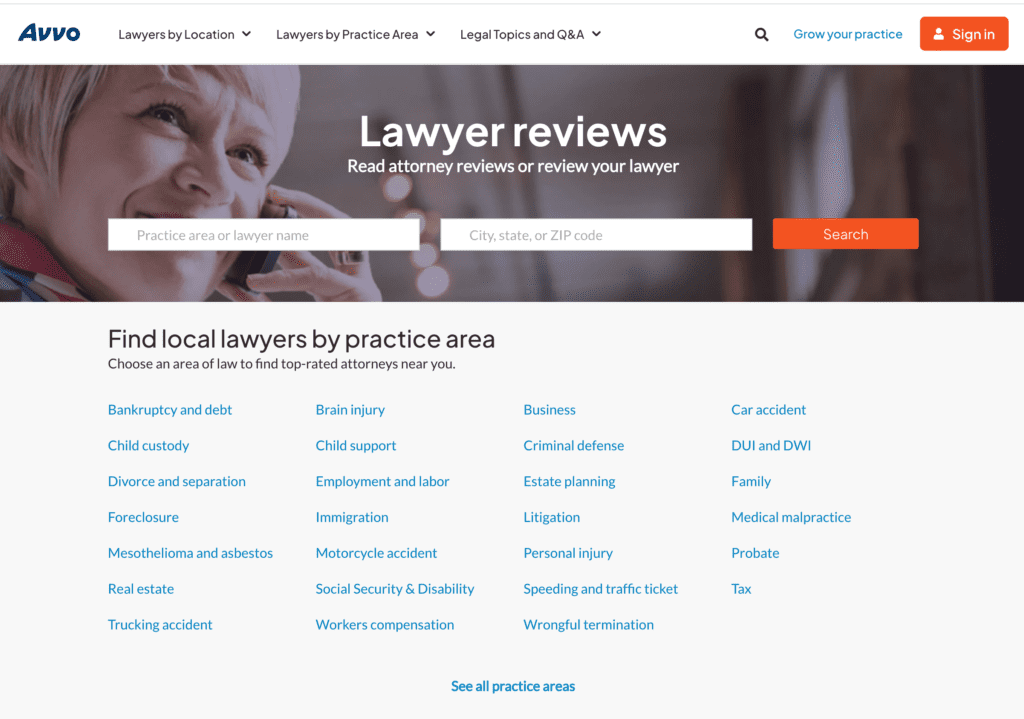
No. Attorneys cannot directly remove reviews from their own Avvo profiles. Only the reviewer who posted the content or Avvo’s moderation team can take a review down and Avvo will only act on a review that violates its published Community Guidelines.
This is consistent across Avvo’s support documentation. The platform considers itself a host of user-generated opinion content protected under Section 230 of the Communications Decency Act, which shields online platforms from liability for content posted by their users. Avvo’s own policy states that reviews are the responsibility of reviewers and that Avvo does not verify or investigate the underlying facts.
What attorneys can do is flag a review for guideline violations, request a formal dispute through Avvo’s Customer Care team, post a public response beneath the review, generate new authentic reviews to dilute its weight and pursue legal action against the reviewer when defamation is a realistic claim.
What Avvo Will (and Will Not) Remove
Avvo removes reviews that violate its Community Guidelines, but it allows critical, harsh, or unflattering reviews to stand when they come from a real client or potential client and do not break a specific rule. Below are the categories Avvo has identified in its published policy as grounds for non-publication or removal.
Reviews From Non-Clients
Avvo’s Community Guidelines state that the platform will not post reviews “that appear to have been left for attorneys with whom you did not consult with outside of Avvo for your own representation.” This includes reviews from opposing parties in a matter, spouses or family members of opposing parties, opposing counsel and anyone reviewing an attorney they have not personally engaged.
If a reviewer is a known opposing party or has no record of any client relationship with your firm, that is one of the cleaner grounds for a dispute.
Accusations of Criminal Activity
Avvo’s published policy is direct on this point: “Reviews that contain accusations of criminal activity against an attorney will not be posted.” Avvo’s stated position is that allegations of criminal conduct belong with law enforcement and bar regulators, not on a public review profile.
Conflict-of-Interest Situations
Avvo permits reviews from non-clients only in narrow circumstances where the payor and the client share aligned interests (a parent paying for a minor’s representation, for example). Avvo’s policy specifically prohibits reviews where:
- Payor and client interests are not aligned
- The attorney was performing the role of a neutral
This commonly comes up in mediation, arbitration, guardianship and probate matters. A review from a party who was not your client and whose interests were adverse to your client’s is reviewable on this basis.
Threats, Harassment and “Play Nice” Violations
Avvo’s “Play nice” rule prohibits name-calling, threats, general rudeness, harassment, lewdness and displays of bigotry. A review that is merely critical of your work is protected. A review that calls you a slur, threatens you, or contains harassing personal attacks falls into removable territory.
AI-Generated or Fabricated Content
Avvo updated its Community Guidelines on November 7, 2025, to require that all submitted content be original and not produced by automated tools such as artificial intelligence. Reviews detected as AI-generated may be removed and repeat violators may face account suspension. If you have evidence that a review was machine-generated, that is now a stated basis for takedown.
Personal Information Disclosure
Reviews that share personal information such as home addresses, phone numbers, social security numbers, credit card numbers, or other sensitive identifiers are subject to removal under Avvo’s safety provisions.
What Avvo Will Not Remove
Reviews that are simply unfavorable, harsh in tone, or critical of your work generally stay up. Avvo states that it does not take sides in factual disputes and does not investigate the substance of what reviewers claim. A one-star review from a real client who felt their case was mishandled is unlikely to be removed even with a thorough dispute, because critical opinion from an actual client is the type of content Avvo’s platform is designed to host.
How to Flag an Avvo Review for Removal
Submitting a dispute to Avvo’s Customer Care team is the first formal step toward removal. The platform reviews flagged content against its Community Guidelines, contacts the reviewer when appropriate and either removes the review, leaves it standing, or allows the reviewer to edit and resubmit.
The process below follows Avvo’s published support documentation.
Step 1: Document the Review
Screenshot the full review, including the reviewer’s name (or username), star rating, full text, timestamp and the URL of your profile. Save copies in case the review is edited or deleted before your dispute is resolved. If the matter later escalates to defamation, this documentation becomes evidence.
Step 2: Identify the Specific Guideline Violation
Match the review to a clear provision in Avvo’s Community Guidelines. A dispute that names the rule (“this review accuses my firm of criminal activity, which Avvo’s policy prohibits”) performs better than one that argues the review is unfair or untrue. Avvo is enforcing its own published rules, not adjudicating the truth of what reviewers claim.
Step 3: Gather Supporting Evidence
Depending on the violation, this may include:
- Conflict checks or matter records showing no attorney-client relationship existed
- Court documents showing the reviewer was opposing counsel or an opposing party
- Communications showing the reviewer is a known competitor or has a personal grievance unrelated to legal services
- Screenshots showing personal information that the reviewer disclosed
You do not need to prove your case beyond a reasonable doubt. You need to give Avvo’s moderation team enough information to determine that the review crosses one of their stated lines.
Step 4: Submit a Request Through Avvo Customer Care
Use Avvo’s contact form to formally request the review be put through the dispute process. Include the review URL, identify the specific Community Guideline you believe was violated and attach or describe your supporting evidence. Keep the tone factual and professional. Avoid emotional language or threats, both of which weaken your position.
Step 5: What Happens During the Review
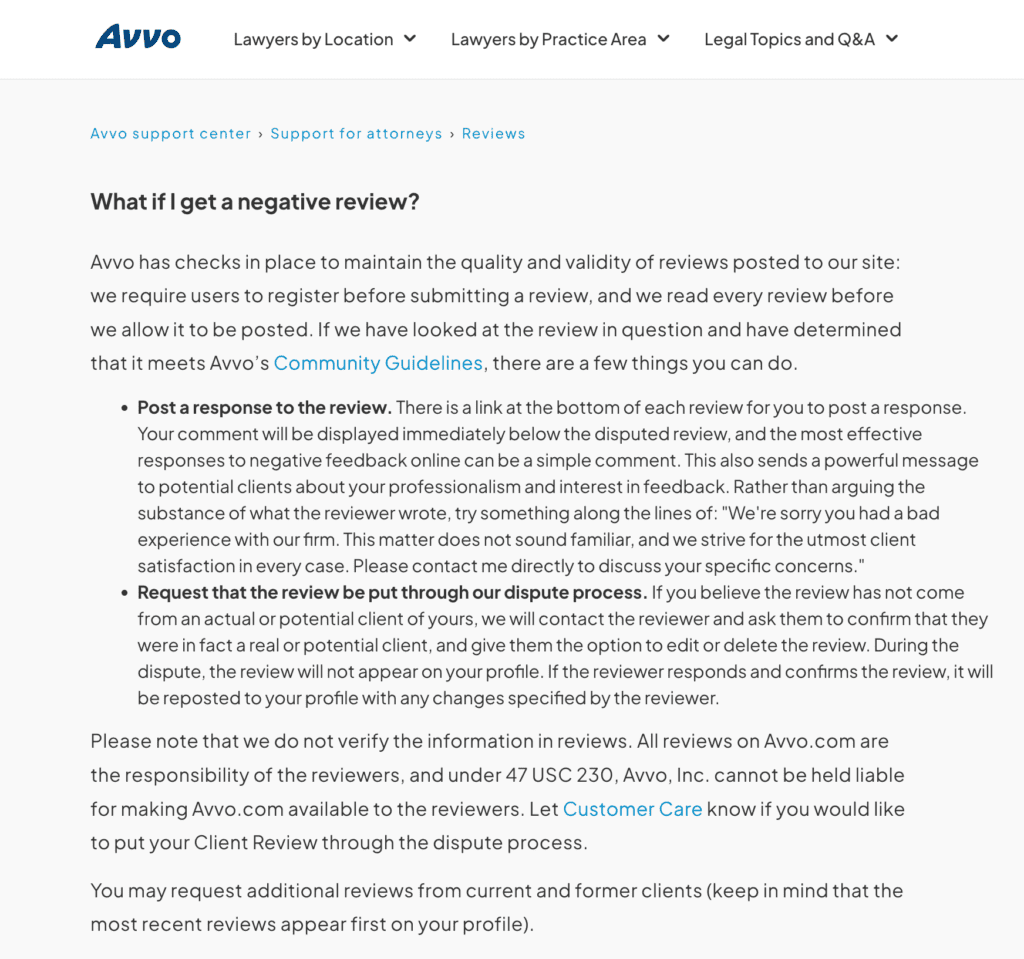
Avvo’s published support documentation confirms that disputed reviews are not visible on your profile while under review. Avvo will typically contact the reviewer to confirm they were an actual or potential client and to address the disputed content. The standard timeline runs roughly 7 to 14 business days, though complex disputes can take longer.
Step 6: The Outcome
Avvo may remove the review entirely, reinstate it without changes, or allow the reviewer to edit and resubmit. If the review is reinstated, it will reappear on your profile. Avvo’s decision is final, though additional violations or new evidence may justify a follow-up dispute later.
What to Do When Avvo Will Not Remove the Review
When a review meets Avvo’s guidelines, it stays up. Your strategy then moves from removal to response, dilution and, in narrow cases, legal escalation.
Post a Public Response
Avvo allows attorneys to post a public response that appears beneath the review. A well-written response often does more for prospective clients than removal would, because it shows future clients how you handle conflict.
Ethics rules constrain what you can say. The American Bar Association’s Formal Opinion 496 (issued January 2021) addresses responding to negative online reviews and warns attorneys against disclosing confidential client information, even to defend their professional reputation. Most state bars have adopted similar positions, though some impose stricter limits.
A safe response template:
“We take all client feedback seriously. We are unable to discuss the specifics of any matter publicly due to our confidentiality obligations. If you would like to speak with us directly about your experience, please contact our office.”
This kind of response is short, professional and reveals nothing that violates Model Rule 1.6 on confidentiality.
Reach out to the Reviewer (With Care)
A measured outside-the-platform conversation sometimes resolves the underlying issue and reviewers occasionally edit or remove their own reviews after that contact. Keep the outreach short and non-confrontational. Acknowledge their experience without admitting fault or disclosing privileged information.
One firm caution: Never offer refunds, fee reductions, or settlements conditioned on review removal. The FTC’s Endorsement Guides and many state bar ethics rules treat compensation-for-removal arrangements as deceptive or unethical practices.
Build Authentic Review Velocity
A single negative review carries far less weight when it sits among twenty-five positive reviews than when it sits alone. Avvo’s built-in “Request Reviews” feature allows you to send review requests to up to 50 contacts at a time. Use it consistently at the close of every matter where the client expressed satisfaction.
You cannot offer incentives in exchange for reviews. You can ask. Most satisfied clients simply forget unless prompted.
When Defamation Law May Apply
Defamation law gives attorneys a potential path to court-ordered removal when a review crosses from harsh opinion into a knowingly false statement of fact. This is the highest-cost and highest-risk option and the standard for winning a defamation claim against a reviewer is intentionally high under U.S. law.
Most negative reviews qualify as protected opinion under the First Amendment. To meet the threshold for defamation in most U.S. jurisdictions, the reviewer’s statement must generally be:
- A false statement of fact, not opinion or hyperbole
- Published to a third party (which online reviews automatically satisfy)
- Made with the required degree of fault (negligence or actual malice, depending on whether the attorney is treated as a public or private figure)
- The cause of demonstrable harm to the attorney’s reputation
Several practical realities make defamation litigation a tool of last resort:
- Pursuing a former client can trigger blowback that ranges from the Streisand effect to bar grievance filings to malpractice counterclaims.
- More than 30 states have anti-SLAPP statutes that give reviewers a fee-shifting defense against meritless suits.
- Successful defamation judgments occasionally result in court orders that Google and Avvo will honor for removal, but the path is slow and expensive.
This section is informational. It is not legal advice. Attorneys considering defamation action should consult outside counsel familiar with their state’s defamation law, anti-SLAPP statute and any applicable bar ethics rules before filing.
Can You Delete or Hide Your Entire Avvo Profile?
In most cases, no. Avvo creates attorney profiles automatically from public state bar records, so attorneys do not choose to opt into the directory and generally cannot opt out by request.
Attorneys can claim an existing profile to add a bio, photo, practice areas, fee information, languages spoken, publications and case results. Claiming the profile also unlocks the ability to respond to reviews. Hiding or removing a profile requires direct contact with Avvo Customer Care and is granted only in limited circumstances.
One important caution: even if Avvo agrees to suppress a profile, the underlying reviews and the URL itself may continue to appear in Google search results and on third-party archive sites. Hiding a profile is a partial measure, not a full reset of your online reputation.
How to Protect Your Avvo Reputation Long-Term
Proactive review management is more effective than reactive removal. A consistent stream of authentic positive reviews dilutes the weight of any single negative review and signals to prospective clients that you maintain a satisfied client base.
A sustainable approach includes:
- Claim and fully complete your Avvo profile, including practice areas, fee structure, bar admissions, languages and recent case results.
- Build a process for requesting reviews at the close of every successful matter. Use Avvo’s “Request Reviews” feature inside your dashboard.
- Monitor your profile at least monthly for new reviews, peer endorsements and Q&A activity.
- Respond to every review within ethical limits. Positive reviews deserve a brief thank-you. Negative reviews deserve a professional response that protects client confidentiality.
- Maintain a healthy Avvo Rating by adding peer endorsements, publications, speaking engagements and case results. (For a full breakdown of what drives the rating, see our guide to the Avvo Rating system.)
When to Bring in Professional Help
Reputation work for attorneys often crosses ethical, legal and technical lines that benefit from outside expertise. Bringing in a professional firm makes sense when:
- A review involves potentially defamatory content and you need a coordinated legal and platform strategy
- Multiple negative reviews appear in a short window (a sign of competitor sabotage or organized harassment)
- Your name returns damaging Google results across multiple platforms (Avvo, Google, Martindale-Hubbell, Lawyers.com, news articles)
- Internal staff lack the time or platform knowledge to manage disputes, response drafting and review generation consistently
A reputable reputation management firm documents and submits guideline-compliant disputes at scale, coordinates with outside legal counsel when defamation may apply, builds out the surrounding search results so negative content moves below page one, runs an ethical client-outreach process for new positive reviews and monitors all relevant platforms for new threats.
NetReputation’s law firm reputation management service was built around the practice realities outlined above, including ABA Opinion 496 compliance, state bar variation and the particular SERP profile of legal directories.
Talk to a Legal Reputation Specialist, 800-200-3000
Frequently Asked Questions
Does Avvo guarantee review removal?
No. Avvo’s published policy is that reviews are removed only when they violate the Community Guidelines and the moderation team makes that determination. No reputation management firm can guarantee a result that Avvo itself does not guarantee.
How long does Avvo take to review a dispute?
Avvo’s support documentation indicates that most disputes are resolved within 7 to 14 business days, though complex cases can take longer. Disputed reviews are hidden from your public profile while under review.
Can I sue Avvo to remove a review?
Section 230 of the Communications Decency Act (47 U.S.C. § 230) generally protects online platforms from liability for user-posted content. Suing Avvo directly is rarely successful. Defamation actions are typically filed against the reviewer, not the platform.
Will responding to a review hurt me?
A thoughtful, professional response is usually a net positive. A response that argues with the reviewer, reveals client information, or sounds defensive will hurt. ABA Formal Opinion 496 and most state bar rules limit what you can say in defense of yourself online and a misstep can lead to a grievance filing.
What if the reviewer was never my client?
That is one of Avvo’s stated grounds for removal. Document the lack of attorney-client relationship (conflict-check records, calendar history, no engagement letter) and submit a dispute identifying the violation.
Avvo’s dispute process is the right first step for any review that violates the platform’s Community Guidelines. For reviews that meet the guidelines, the work shifts to careful response, sustained review generation and (in narrow cases) defamation analysis. The attorneys who protect their profiles best treat Avvo as one part of a broader law firm reputation strategy.
 800-200-3000
 Rated #1 by Newsweek
 4.9/5 Trustpilot
 100% Confidential