 800-200-3000
Key Takeaways
- Personal injury clients usually contact only one or two lawyers before signing, which makes the first impression in search results decisive.
- Settlement outcomes drive review patterns that other practice areas rarely see, including reviews from clients whose award did not match expectations.
- Competitor sabotage through fake one-star reviews is more common in personal injury than in any other legal vertical, and Google’s automated systems miss most of it.
- A balanced personal injury lawyer reputation strategy weighs Google Ads spend against organic visibility, because paid traffic without strong reviews converts at a fraction of what a well-reviewed firm earns.
- Publishing case results requires careful framing to stay within state bar advertising rules and ABA Model Rules.
Personal injury firms operate in the most reputation-sensitive corner of legal services. A claimant facing medical bills, lost wages, and an insurance adjuster on the phone has hours to choose counsel, not weeks. The firms that win those calls are the ones whose Google reviews, Avvo profile and search results reassure a stranger in under sixty seconds.
This guide covers why personal injury reputation behaves differently from other practice areas, the platforms that matter most, and the tactics PI firm partners and marketing directors use to protect their brand. It also draws on guidance from the American Bar Association, the Clio Legal Trends Report and platform documentation from Google and Avvo.
Why Personal Injury Reputation Carries Outsized Weight
Personal injury law firm reputation matters more than reputation in most other practice areas because the buying decision happens fast and the alternatives are everywhere. In fact, a car accident victim, a workplace injury claimant or a slip-and-fall plaintiff typically contacts only one to two lawyers before signing a fee agreement, according to the Clio Legal Trends Report 2024.
So it’s easy to see that the firm that ranks well and looks credible wins the case.
A few features of PI client behavior amplify the reputation’s role:
- Urgency compresses the research window. Clients dealing with hospital stays and missed work do not run six-vendor evaluations. They look at the top of Google, the local pack and the first few Avvo profiles.
- Each case is worth more under contingency fees. A PI firm earns nothing if it loses, so a small cost-per-lead difference compounds across a year, and strong reviews lower CPL on both paid and organic channels.
- Competition is dense and well-funded. PI carries some of the highest CPCs in legal marketing, with major metros seeing $200+ per click on Google Ads. Therefore, reputation determines whether that click converts.
BrightLocal’s Local Consumer Review Survey 2024 found that the vast majority of consumers read online reviews for local services, with legal services among the categories where review volume and average rating most strongly influence selection.
A solo car-accident attorney with 27 four-star reviews on Google will frequently outconvert a 60-attorney firm with eight reviews and a higher ad budget. Reputation is the multiplier on every other marketing investment a PI firm makes.
For a broader context on how reputation works to support legal practices, see our pillar guide on reputation management for lawyers.
How “I Need a Lawyer Now” Search Behavior Shapes PI Reputation
Urgent search behavior shapes PI reputation by forcing the entire decision into the search results page itself. Most personal injury clients never visit a firm’s website during the first session. They build their shortlist from the local pack on Google, the Avvo carousel and any directory result that appears above the fold.
The assets a prospective client sees first are:
- The Google Business Profile star rating and review count
- The Avvo rating, when an Avvo result appears in the SERP
- Snippets from review sites pulled into knowledge panels
- Sitelinks under the firm’s main listing
- Local pack ratings for nearby competitors are visible in the same scroll
A PI firm with a 4.8-star Google rating across 80 reviews and a 9.0+ Avvo rating frames the decision before the user clicks anything. In fact, a firm without those signals is functionally invisible at the moment of decision, no matter how skilled the lawyers actually are.
For PI firms operating multiple offices, this means Google Business Profile management is not optional. Each office location needs its own GBP, its own review velocity and its own response pattern.
The Billboard Wars and Lead-Gen Aggregator Pressure
Personal injury firms compete against two forces that other practice areas do not face at the same intensity. For example, legacy billboard advertisers with enormous brand recall and digital lead-generation aggregators that intercept search traffic before it reaches any law firm.
Therefore, reputation work is how mid-sized PI firms compete against both.
Competing Against Legacy Brand Advertisers
In markets like Los Angeles, Houston, Atlanta, and Philadelphia, a handful of firms have spent decades building name recognition through billboards, TV, and radio. Their brand-name search volume can dwarf any organic SEO effort.
Conversely, mid-sized firms rarely outrank these incumbents on brand-name searches, and chasing that traffic is the wrong fight. The opportunity sits in the much larger volume of generic queries (“car accident lawyer near me”, “best motorcycle accident attorney”) where reputation signals decide who looks credible.
Accordingly, a consistent five-figure investment in review generation, response cadence and content publishing creates the credibility cushion that lets a smaller firm punch above its weight on those non-brand queries.
Competing Against Lead-Gen Aggregators
Sites like LegalMatch, FindLaw’s lawyer match and aggressive PPC affiliates often outrank individual firms on commercial PI keywords. They then resell the lead to multiple firms, putting the eventual client into a bidding war and damaging the firm’s relationship with the client.
The PI firms that pull traffic away from aggregators typically do these three things well:
- Build out long-tail content around specific accident types, jurisdictions, and case scenarios so they own the search demand, whereas the aggregators do not bother covering them.
- Maintain superior review depth so that when a user lands on a comparison page, the firm’s profile outshines the surrounding noise
- Optimize their own Avvo, Justia and Super Lawyers profiles so aggregator listings are not the only well-optimized pages mentioning the firm
Reputation signals are what convert that recovered traffic. Strong rankings without strong reviews still leak to better-reviewed competitors one scroll away.
Reviews That Land Differently for PI Firms
Personal injury reviews behave differently from reviews in other industries because the underlying client experience is shaped by settlement outcomes, insurance dynamics and emotional aftermath. Hence, negative reviews in PI are often less about the lawyering and more about the client’s grief, financial pressure or unrealistic expectations going in.
A few patterns recur:
| Review pattern | What it often reflects | How leading PI firms handle it |
|---|---|---|
| “They got me less than I deserved.” | The client expected a larger settlement; the adjuster’s offers came in low | Set expectations early; document offer history; respond with empathy without disclosing case details |
| “They took too long.” | Insurance carrier delays; medical liens not yet resolved | Communicate proactively during slow phases; explain that lien negotiations are the bottleneck, not the firm |
| “They wouldn’t take my case.” | Firm declined representation; client posts a review anyway | Politely note that the firm takes only cases it believes it can serve well; do not confirm or deny details |
| “Best decision I ever made” | High client satisfaction post-settlement | Respond promptly with thanks; ask for a Google review if the original was elsewhere |
The throughline is that PI review responses require more restraint than reviews in other industries. So, confirming whether someone was a client, what their case involved or what their settlement was can trigger confidentiality issues.
ABA Formal Opinion 496 (issued January 2021) lays out the limits in detail, and most state bars have followed its framework.
Handling Competitor Sabotage and Fake Reviews
Unfortunately, competitor sabotage is more common in personal injury than in any other legal vertical, and most established PI firms encounter it at some point.
Some patterns to watch for include sudden clusters of one-star reviews from accounts with no prior review history, reviews citing facts about the firm that no real client would know and reviews that appear within hours of the firm winning a high-profile case or running a new ad campaign.
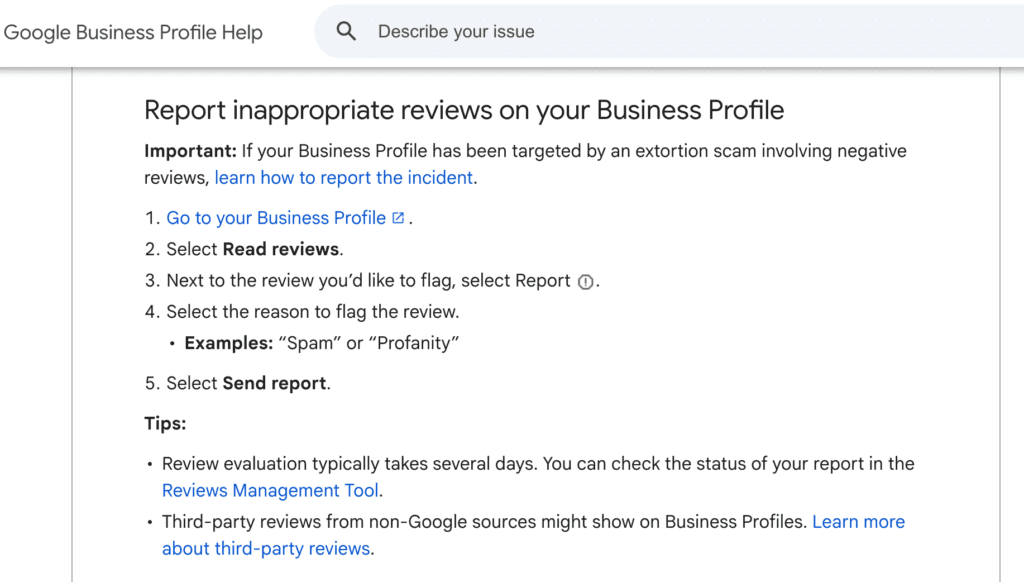
Google’s review policies prohibit fake engagement, including reviews posted by competitors, by non-clients impersonating clients and by reviewers paid to defame a business. Google’s published documentation describes the categories of prohibited reviews and the flagging process. Removal is never guaranteed, and the evidence bar is high.
Productive responses to a suspected competitor attack include:
- Documenting the reviewer accounts, the timing of each review, and any patterns across platforms (a coordinated attack often appears on Google, and Avvo within the same week)
- Flagging each review through Google’s standard removal flow with specific policy citations
- Filing an escalation through Google Business Profile support when standard flagging fails
- Considering a defamation evaluation for the most damaging reviews, if the firm can identify the source
- Engaging review removal specialists when in-house attempts stall
Defamation litigation is a last resort and rarely the right tool for an isolated fake review, but it remains a real option for coordinated campaigns. For firms that have already exhausted Google’s process, NetReputation’s content removal services and our guide to removing a Google review cover the available paths. For coordinated attacks unfolding in real time, see our crisis management service.
No reputation management firm, including NetReputation, can guarantee the removal of any specific review. It’s important to keep in mind that outcomes depend on platform discretion and the strength of the policy violation.
Google Ads vs Organic Visibility for Personal Injury Firms
Most PI firms over-index on Google Ads and under-invest in the organic and reputation work that makes those ads convert. The two channels are not interchangeable, and reputation determines the cost of both.
Google Ads delivers traffic on demand. It is essential in competitive PI markets because the top of the SERP is dominated by ads, and organic results may not appear above the fold on mobile. The downside is that PI cost-per-click can exceed $200 in major metros, and that click is wasted if the landing experience or review signals do not earn trust within seconds.
Organic visibility compounds over time. Strong rankings on practice-area pages, accident-type guides, and jurisdiction-specific content lower the firm’s dependence on paid traffic and create assets that earn leads in perpetuity. Reputation signals (review count, average rating, Avvo rating, Martindale rating) influence click-through rate on every organic position the firm holds.
Reputation is the multiplier on both. A firm running $50,000 per month in Google Ads with a 3.9-star average pays significantly more per acquired client than a firm running the same amount with a 4.7-star average, because conversion on every landing page is gated by the trust signals visible alongside it.
The PI firms that grow most efficiently tend to follow this rough order of operations:
- Get review fundamentals right (volume, recency, response cadence)
- Lock in Google Business Profile optimization across all office locations
- Develop organic content around the firm’s strongest practice areas
- Then scale Google Ads against the reputational foundation now in place
For firms with stronger ad operations than organic operations, our SEO services and business review management pages cover the underlying frameworks.
Case Results Publication: What You Can and Cannot Say
Publishing case results is one of the most effective reputation tools available to a PI firm, but it sits in a heavily regulated space governed by state bar advertising rules and the ABA Model Rules of Professional Conduct. In fact, many firms either avoid the topic entirely or publish in ways that create disciplinary exposure.
Common rules across state bars include:
- Truthfulness: The result must be accurate. Misrepresenting a verdict, a settlement amount or the circumstances of a case is prohibited in every jurisdiction.
- Disclaimers: Most state bars require language noting that prior results do not guarantee future outcomes. Some require specific wording.
- Confidentiality: Client identifying details cannot be published without informed consent. Settlement amounts subject to confidentiality agreements cannot be disclosed, regardless of how the firm frames the publication.
- Comparisons: Several states restrict comparative claims (such as “the largest verdict in county history”) unless the firm can substantiate them.
Practical guidelines that align with most jurisdictions:
- Anonymize client names and identifying details unless the client has provided clear written consent to be identified
- Include the standard “prior results do not guarantee similar outcomes” disclaimer on any case-result page and within any individual result summary
- Verify the firm’s state bar advertising rules before publishing, since California, Florida, Texas, New York and several other states impose additional disclosure requirements
- Avoid superlatives (“largest”, “best”, “record”) unless the firm has documentation that can support the claim under bar scrutiny
Well-executed case-result content also strengthens organic visibility. Pages built around specific accident types, courts and result summaries often capture long-tail traffic that aggregator listicles do not bother targeting.
This guide is informational and does not constitute legal advice. Each firm should review its own state bar advertising rules before publishing case results, ideally with input from internal ethics counsel.
Building a Reputation Defense Plan for Your Personal Injury Practice
A reputation defense plan for a PI practice has four components that work together rather than in isolation: monitoring, generation, response and escalation.
Monitoring comes first. Every PI firm needs daily visibility into reviews and mentions across Google Business Profile, Avvo, Facebook, state bar listings and any aggregator the firm appears on. Monitoring software flags new reviews within minutes, which is critical when a competitor attack is unfolding.
Steady review generation creates the volume cushion that absorbs the occasional bad review. The most reliable approach is a post-settlement workflow: when a client signs the settlement disbursement paperwork, the case manager sends a personalized review request within 24 hours. Review generation must comply with platform rules, which generally prohibit incentivizing reviews or asking only satisfied clients.
Response is non-negotiable. Every review, positive or negative, gets a reply within 48 hours. Replies to negative reviews follow the constraints of ABA Opinion 496 and the firm’s state bar guidance, which generally means acknowledging the reviewer’s experience without confirming or denying client status or case details.
Escalation is the path when a review crosses into defamation territory, when a coordinated attack is underway or when standard flagging has failed. That path may involve internal counsel, outside ethics counsel, a professional review removal specialist or all three.
For PI firms that want a custom assessment of their current reputation posture, NetReputation’s legal reputation management service provides industry-specific audits and ongoing management. We also serve adjacent practice areas with similar reputational dynamics.
Schedule a Free Reputation Analysis | 800-200-3000
Frequently Asked Questions
How long does it take to repair a damaged personal injury firm’s reputation?
A damaged PI reputation typically takes six to eighteen months to repair, depending on the source and volume of negative content. Review-driven damage that can be addressed through generation and response moves fastest. Damage from news coverage, lawsuit publicity or coordinated competitor attacks takes longer because each affected asset must be addressed individually.
Are competitor reviews actually removable?
Reviews proven to be from competitors or non-clients can be removed by Google when the violation is well-documented, but removal is never guaranteed. Google’s automated systems miss most coordinated attacks, and successful removal often requires escalation through Google Business Profile support or a defamation evaluation when the source can be identified.
Should a PI firm respond to every negative review?
Yes, every negative review should receive a response within 48 hours. Responses should acknowledge the reviewer’s experience without confirming or denying client status, and they should not disclose case details. ABA Formal Opinion 496 governs the limits of permissible response.
Does NetReputation guarantee review removal?
No reputable reputation management firm can guarantee the removal of any specific review. NetReputation offers a satisfaction guarantee on full removal campaigns, but outcomes on any individual review depend on the platform’s discretion and the strength of the policy violation. We do not pursue tactics that violate platform terms of service or bar advertising rules.
 800-200-3000
 Rated #1 by Newsweek
 4.9/5 Trustpilot
 100% Confidential