 800-200-3000
Family law is the only practice area where the opposing party can leave a Google review of you. Divorce and child custody work draws negative attention from people who were never your clients, in ways most other lawyers never experience.
In fact, the bar rules that govern how attorneys talk about clients online were not written with one-star reviews in mind, and the public nature of divorce records means a frustrated ex-spouse can build a case against your reputation using documents anyone can pull from a county clerk’s website.
Key Takeaways
- Family law firms get reviewed by people who were never clients, including ex-spouses, in-laws and opposing parties.
- Public divorce filings let critics back up online attacks with case numbers and court records that look authoritative.
- ABA Formal Opinion 496 prohibits using client information to defend yourself in a review response, even if the review is misleading.
- Anonymous review platforms remove the consequence for false statements, which makes proactive review generation the strongest defense.
- Social media missteps that look ordinary in other practices, like commenting on a custody case, can trigger ethics complaints in family law.
- A consistent flow of authentic client reviews and a clean Google Business Profile do more than any single takedown attempt.
Why Family Law Reputation Is a Different Problem
Family law reputation is harder to manage than almost any other legal vertical because the people writing about your firm online are often not your clients. In personal injury, civil litigation, business law and estate planning, online reviews come almost exclusively from people who hired the attorney.
However, in divorce and custody work, the entire opposing party (and frequently their family, friends and new partner) has both motive and standing to write something negative. The result is a reputation environment where some of the loudest voices in search results never paid the firm, never signed a retainer, and have a documented adversarial relationship with the lawyer’s actual client.
Combine that with the emotional volatility of divorce, the public-record nature of family court and the strict confidentiality rules attorneys are bound by, and the work of reputation management for lawyers takes on a shape that does not appear in any other practice area.
The Five Reputation Pressures Unique to Divorce and Family Law
Five specific dynamics make divorce and family law reputation work harder than the rest of the legal field.
Clients Are in Crisis When They Hire You and When They Review You
Divorce, custody disputes and protective order work intersect with the worst weeks of a client’s life. A client who felt let down by a hearing outcome, a settlement amount or even the pace of communication is more likely to translate that disappointment into a public review than a client in a transactional matter. The same emotional intensity that brings family law clients to a firm also shapes how they describe the firm afterward.
Divorce Court Records Are Public, and People Use Them
In most U.S. states, the index of divorce filings, custody petitions and final judgments is publicly accessible through county clerk websites or court portals. Therefore, a motivated ex-spouse can cite a case number, attach a screenshot of a docket entry, or quote a filing from a public record while writing a one-star review.
That gives a misleading review the appearance of being substantiated, which makes it harder to dismiss as fiction. If a court record contains content that no longer needs to be searchable, our guide on how to remove court records from the internet walks through the legal and platform routes available.
Ex-Spouses, In-Laws, and Opposing Parties Leave Reviews
Google’s review policies do not require a reviewer to have been a paying customer of the business being reviewed. While Google’s content guidelines prohibit conflict-of-interest reviews and reviews unrelated to the business, enforcement is inconsistent.
For example, an ex-spouse can leave a review of opposing counsel, an angry in-law can post on behalf of a relative and a new partner of an ex can pile on. Flagging these reviews is sometimes effective and sometimes not.
Our walkthrough on how to dispute a Google review that’s hurting your business covers the steps and the realistic outcomes.
Child Custody Confidentiality Narrows Your Response Options
Custody matters often involve sealed records, protective orders and statutory confidentiality provisions covering children’s identities. Even when the parent posts publicly about the case, the attorney is constrained by court order, by statute, and by ABA Model Rule 1.6 on client confidentiality.
As a result, a response that would be a normal “we serve all clients with care” answer in another industry can put a family law attorney at risk of an ethics complaint if it implicitly confirms representation, identifies a minor or references a sealed proceeding.
Anonymous Review Platforms Remove the Deterrent
Avvo, Google and most general review platforms allow anonymous or pseudonymous reviews. While defamation law exists, practical recovery against an anonymous reviewer requires subpoenaing the platform, identifying the user and bringing a civil action that may cost more than the reputation harm itself.
Many family law clients (and their adversaries) understand this and write accordingly. The deterrent is weak, which means the supply of negative content is structurally higher than in most other industries.
97% of consumers read online reviews for local businesses, per BrightLocal’s Local Consumer Review Survey, 2026.
How to Respond to Negative Reviews Without Violating Bar Ethics
Family law attorneys have less freedom in review responses than almost any other professional and the rules have tightened recently.
In January 2021, the American Bar Association issued Formal Opinion 496, which states that a lawyer responding to an online review may not disclose information relating to the representation of a client without that client’s informed consent, even when the review is negative or misleading. The “self-defense” exception in Model Rule 1.6 typically does not apply to online reviews because a review is not a formal proceeding against the attorney.
This means the instinct to “set the record straight” by explaining what really happened in the case is, in most states, an ethics violation. A practical response framework that stays inside those bounds usually looks like this:
- Decline to confirm or deny that the reviewer was a client.
- Acknowledge the importance of feedback in general terms.
- Invite the reviewer to take the conversation offline, ideally to a phone number that does not require disclosing case details.
- Reaffirm the firm’s commitment to professionalism without referencing any specific facts.
A response that follows this pattern is short, neutral and gives prospective clients the signal that the firm takes feedback seriously without putting the responding attorney in front of a disciplinary committee.
Keep in mind that state bars vary in how they apply Opinion 496, and several have issued additional guidance, so any response policy should be checked against the firm’s home jurisdiction.
NetReputation does not provide legal advice. The framework above is informational and attorneys should consult their state bar ethics rules for specific guidance.
Managing Reviews From People Who Were Never Your Clients
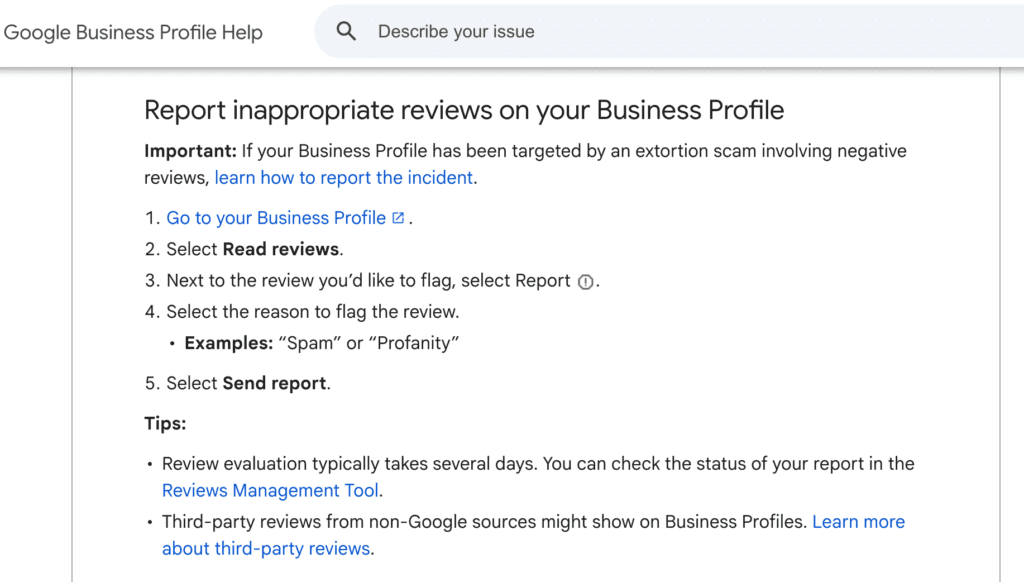
When the reviewer was never a client, the response strategy and the removal strategy are different from a normal “unhappy customer” situation. The two paths to pursue are platform-level removal and reputation displacement.
Platform-level removal starts with reporting the review under the platform’s content policies. Google’s review policies prohibit reviews based on conflicts of interest, including reviews left by people with a personal grudge against the business owner rather than experience with the business itself. While Avvo’s content guidelines exclude reviews from non-clients.
Reporting these reviews with a clear explanation (and, where available, documentation showing the reviewer was not a client or had an adversarial relationship to a client) is the first step. Removal is not guaranteed, and platforms do not always agree that an ex-spouse review qualifies for removal, but consistent reporting raises the odds.
When removal is not possible, the content removal team approaches the problem from the search results side: pushing the review down by elevating positive, authoritative content above it. A well-managed Google review management program and a steady flow of legitimate client reviews dilute the weight of any single hostile post over time.
For families dealing with content that goes beyond reviews, such as defamatory blog posts or social media campaigns, crisis management services address coordinated reputation attacks that go beyond a single bad review.
Protecting Attorney-Client Confidentiality Across Reputation Channels
The reputation channels a family law firm uses (website testimonials, case study pages, social media, blog content and review responses) each carry confidentiality risks, and the rules apply even to information that is technically public. A few specific guardrails apply:
| Channel | Confidentiality risk | Practical guardrail |
|---|---|---|
| Website testimonials | Naming a client confirms representation, even with their consent | Use first name and last initial only; obtain written consent on a form that references Model Rule 1.6 |
| Case study pages | Details can identify the client even without a name | De-identify case facts, change jurisdictions if possible, and consider whether the case is recognizable to the opposing party |
| Social media | Commenting on current events related to a sitting case can be construed as referencing the matter | Maintain a posting policy that excludes any topic connected to an active or recently closed case |
| Review responses | The reviewer’s identity may be implied by case details | Never confirm or deny the existence of an attorney-client relationship in a response |
| Press inquiries | Quoting the firm on a publicized divorce can violate confidentiality even if the case is in the news | Adopt a “no comment on current or former representations” default policy |
For attorneys whose personal name dominates the firm’s reputation (which is the norm for solo and small family law firms), personal reputation management covers the attorney’s own searchable name in addition to the firm’s. The two reputations are tightly coupled in family law, where clients often Google the lead attorney before they Google the firm.
Social Media Risks Are Unique to Family Law Practice
Social media creates faster and more public reputation problems for family law attorneys than for almost any other practice area, because the content overlaps with the same emotional territory the firm works in every day.
A post about a high-profile celebrity divorce, an opinion on a recent appellate decision or a comment in a Facebook attorney group can become evidence in a client’s case or fuel for an opposing party’s complaint. Three patterns cause the most damage:
- Posting about a current or recent case, even in general terms, when the facts are recognizable to anyone connected to it.
- Engaging with reviews or social media posts about the firm in a defensive tone that confirms representation by responding at all.
- Reposting or commenting on news stories about family law issues that, in context, can be read as expressing a view on a pending matter.
A documented social media policy for every attorney and paralegal at the firm reduces the surface area for these mistakes. The policy should cover personal accounts as well as firm accounts, because in a family law context, a paralegal’s vacation photo with the lead attorney can become Exhibit C in a custody hearing.
Where Divorce and Family Law Firms Should Focus First
Most family law firms get the best return from a small set of high-leverage reputation moves rather than a sprawling program. Focus on the first 90 days here:
- Claim and optimize the Google Business Profile. A complete, accurate and actively managed profile is the single most important off-page asset for a family law firm. Add practice-area attributes, real photos and consistent NAP information across every directory.
- Build a steady review request workflow. Send a review request at the close of every matter where the client’s outcome was acceptable. Use the Google review management framework to keep the volume consistent over time.
- Audit the major legal directories. Claim and complete profiles on Avvo, Martindale-Hubbell, Super Lawyers, Lawyers.com, FindLaw, Justia and the state bar’s lawyer locator.
- Document a review-response template aligned with ABA Opinion 496. Every attorney at the firm should use the same general structure, and the firm should keep a record of which reviews were flagged, when and why.
- Set up brand monitoring for the firm name and each attorney’s name. Google Alerts is free, but a more robust monitoring tool catches mentions on review platforms and social media that Alerts misses.
- Plan for the harder reputation problems before they happen. Identify in advance which attorney handles a defamation issue, which platform contacts the firm uses and at what point outside help comes in. For litigation involving online harm, NetReputation’s expert witness services team supports family law attorneys with damage quantification and SEO testimony.
When to Bring in a Professional Reputation Team
A family law firm should consider outside reputation help when one of three conditions is true. The first is a coordinated attack, where an ex-spouse or organized group is leaving reviews across multiple platforms in a short window. The second is a search-result problem, where negative content holds positions one through five for the firm’s name or a partner’s name. The third is the moment a state bar inquiry, news story or viral social media post turns into a multi-channel reputation event.
In each of those situations, the firm’s options narrow quickly. Removal requires platform-specific knowledge, search displacement requires sustained content publishing and crisis response requires a playbook prepared before the event rather than written during it.
Law firm reputation management services for family law practices are built around those three triggers, and the work usually moves faster when the firm engages before the problem reaches public visibility, rather than after.
A More Durable Reputation Posture
The family law firms that emerge from difficult reputational moments with their business intact share a few habits.
They keep the flow of legitimate client reviews consistent enough that one or two bad reviews do not move the average. They train every staff member on the ethical rules governing case information, both online and offline. They monitor the firm’s name and each attorney’s name with enough frequency to catch new content within a day or two of publication, not weeks. And they have a relationship with legal reputation management services and review-platform contacts established before the crisis, not during it.
None of this is about silencing critics or burying lawful speech. It is about giving prospective clients an accurate picture of the firm when they go searching, and about preventing one motivated adversary from defining the firm’s online identity.
For attorneys in a field where the opposing party can become a reviewer, that posture is the difference between a steady practice and one that loses every borderline client to a competitor with a cleaner first page of Google.
 800-200-3000
 Rated #1 by Newsweek
 4.9/5 Trustpilot
 100% Confidential