 by Valeria G
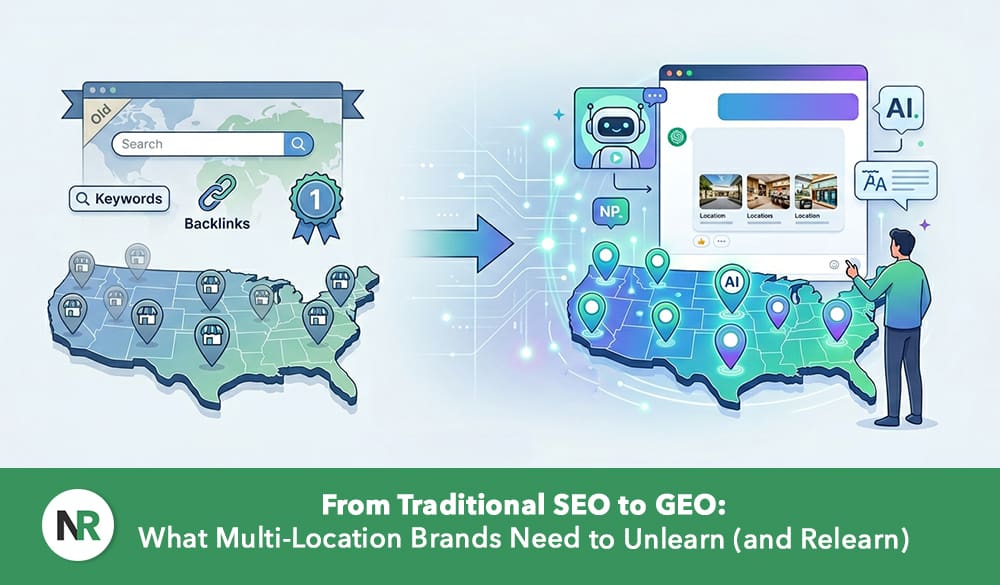
Most multi-location brands have spent years building their digital marketing strategy around traditional SEO. They’ve chased backlinks, stuffed location-specific keywords into page titles, and ranked for broad terms. And for a while, it worked.
But search has changed fast.
According to Google data, 70% of searches are now local. That means a multi-location business marketing strategy built on generic, brand-level keywords is invisible to most of its potential customers. You’re not losing on quality. You’re losing on relevance.
This guide breaks down what’s changed, what you need to stop doing, and what actually works now, especially as AI-powered search engines reshape how local search results are returned.
What Is Traditional SEO vs. AI-Driven Search?
Traditional SEO focuses on keywords, backlinks, and ranking factors in Google’s search results pages. It works well for single-location marketing. But at scale, across multiple locations, it breaks down quickly.
AI-driven search is built around how tools like Google’s AI Overviews, ChatGPT, Gemini, and Perplexity actually work. These tools don’t just rank pages. They generate answers. They pull from structured data, entity signals, and content that directly answers a query.
For multi-location brands, that’s a fundamental shift. Your digital marketing strategy can no longer rely solely on broad keyword targeting. It needs to speak to local audiences, with structured data that AI crawlers can actually read and use.
The core framework for AI-driven search visibility is the S-E-T model: Structure, Explainability, and Trustworthiness. These three pillars determine whether your brand shows up in AI-generated answers or gets ignored entirely.
What Multi-Location Brands Need to Unlearn
1. Generic, one-size-fits-all keywords
Targeting “best plumber near me” across 50 markets doesn’t work. It dilutes your signal across all of your locations, confuses search engines about which location is most relevant, and fails to connect with local customers looking for something specific to their area.
Each location needs its own keyword strategy. Location-specific keywords tied to individual landing pages, not just city names bolted onto a generic page, are the foundation of effective local SEO.
2. One-size-fits-all content
Content that says nothing specific about a location serves no location well. AI search systems reward high fact density and local relevance. Generic brand content can’t compete with localized content that references specific communities, local events, or neighborhood context.
Local teams and individual locations need localized blog posts, location pages, and local content that reflects what’s actually happening in that market. That’s what builds local relevance.
3. Ignoring local signals
NAP consistency means your business name, address, and phone number must be accurate and identical across every online listing, directory, and platform. Inconsistent information confuses search engines and hurts local search results.
And it’s not just NAP. Online reviews, Google Business Profile data, local citations, and social media engagement all send signals that affect local visibility. Ignoring any of these weakens your entire digital presence.
4. Relying on keyword stuffing and backlinks alone
Traditional search optimization levers, like keyword density and backlink volume, don’t drive AI search rankings the way they used to. Modern search demands machine-readable structured data, schema markup, and answer-ready content. Without these, your location pages are largely invisible to AI crawlers, no matter how many backlinks you’ve earned.
What Multi-Location Brands Need to Relearn
1. Location-specific keyword mapping
Each location needs its own keyword strategy, tied to a dedicated location page. A hub-and-spoke model works well: a central brand page sets brand identity and core messaging, while individual location pages target local searches with location-specific content.
For a retail brand with 30 stores, that means 30 distinct location pages, not one page with a dropdown. Each page should have unique content, local business information, accurate store hours, and structured schema markup.
2. Hyper-local content at scale
This is the hardest part of multi-location marketing, and it’s where most brands fall short. Local content needs to go beyond address and hours. It should include references to local communities, local events, neighborhood context, and anything that tells a search engine and a local customer that this location is genuinely part of that market.
Templates help. But they need to be built to accommodate real local customization, not just find-and-replace for a city name. Local teams should have the tools and brand-approved marketing campaigns to create and publish content that reflects their market.
3. Google Business Profile optimization
Every location needs a fully optimized Google Business Profile. That means accurate NAP, updated photos, regular posts, and active review management. These profiles are direct inputs into local search results, map results, and AI-generated answers.
Consistent branding across profiles matters. But so does local customization. Photos should reflect the actual location, not just stock imagery. Posts should reference local events or offers. Reviews should be responded to promptly.
4. Structured data and schema markup
Implementing the LocalBusiness, Review, Service, and FAQ schemas is no longer optional for multi-location businesses. These schemas tell search engines exactly what each location is, where it is, what it offers, and how customers rate it.
Without this structured data, AI crawlers have to guess, and they often guess wrong or skip your locations entirely. This is one of the highest-leverage changes any multi-location marketing strategy can make.
5. Content governance and keyword ownership
Multi-location brands often create an internal search problem: multiple location pages targeting the same keywords and competing with each other. This is called keyword cannibalization, and it actively hurts search visibility.
Corporate-level content should target broad, brand-wide topics. Location pages should target local searches and serve local audiences. A shared content strategy with clear keyword ownership by location prevents internal competition and lets every page rank for its intended audience.
Common Mistakes to Avoid
1. Poor entity accuracy
If your business name, address, or phone number varies across directories and platforms, search engines lose confidence in your data. Clean, consistent local business information across all sources is foundational.
2. Missing share of answer
AI search generates direct answers. If your content isn’t structured to answer specific local queries, such as “best coffee near downtown Austin,” you won’t appear in those answers, no matter how strong your traditional search presence is.
3. No local review management program
89% of consumers read online reviews before making a purchase decision. A negative review at one location can affect the perception of your entire brand. You need a systematic approach to monitoring reviews, responding quickly, and using feedback to improve customer experience across all locations.
4. Duplicate content across location pages
Copy-pasting the same content across every location page is a real problem. Search engines treat duplicate content as low-value, and AI search systems have even less patience for it. Each location page needs genuinely distinct content.
5. No local digital presence beyond the website
Maintaining brand consistency across your website isn’t enough. Social media engagement at the local level, local business listings, and location-specific landing pages all contribute to local search rankings and local visibility.
How to Measure Success Across Locations
Traditional search metrics, such as keyword rankings, domain authority, and backlink count, don’t fully capture how well your multi-location marketing efforts are performing. You need different KPIs.
1. Share of answer
How often does your brand appear in AI-generated responses to relevant local queries? This is increasingly important as AI Overviews and answer engines dominate the top of search results.
2. Local search visibility by location
Are each of your location pages appearing in local search results for their target market? Track this location by location, not as an aggregate.
3. Google Business Profile performance
Clicks, calls, direction requests, and photo views per location tell you whether your profiles are driving foot traffic.
4. Review volume and rating trends
Across individual locations, are reviews improving? Are response times decreasing? These directly affect local rankings.
5. Location page traffic and conversions
Each location page should deliver measurable results, whether in the form of visits, calls, form submissions, or in-store visits. If a page isn’t converting, it needs better local content, stronger local SEO, or both.
The Right Tools for Multi-Location Marketing
Managing multi-location marketing efforts without the right tools is slow, inconsistent, and error-prone. The right marketing plan includes technology for:
- Local listings management to keep business information accurate across all directories and maps
- Review management to monitor and respond to reviews across all locations at scale
- Location-specific ad targeting for geo-targeted marketing campaigns that reach local customers in each market
- Content distribution to give local teams access to brand-approved marketing campaigns while allowing local customization
- Marketing analytics to track performance by location, so you can identify what’s working and what isn’t
Platforms that centralize these functions enable a consistent brand identity while allowing real local customization across every location. Spending smarter starts with having visibility into what’s driving results at the local level.
The Bottom Line
Multi-location marketing is harder than single-location marketing. That’s not a knock, it’s just reality. You’re balancing a consistent brand identity across dozens or hundreds of markets, each with its own local customers, local competitors, and local search behavior.
Traditional search strategies gave you a playbook for brand-level visibility. Modern AI-driven search gives you a playbook for local visibility, which is where most of your potential customers are actually searching.
The brands winning local search right now are the ones that have made the shift: structured data, location-specific content, hyper-local keyword mapping, and clean, consistent business information everywhere their customers look.
The brands losing are still running a multi-location marketing strategy built for 2015.
Which one are you?