 800-200-3000
This 2026 evaluation has been updated to reflect major industry changes, including AI Overviews, generative engine optimization (GEO) and the Federal Trade Commission (FTC)’s August 2024 final rule targeting fake reviews and deceptive testimonials.
Maintaining a solid and favorable online presence is more important than ever for businesses of all sizes. Negative reviews, unfavorable press coverage, misleading search results and damaging social media conversations all influence customer trust, hiring decisions, partnerships and revenue growth. As explained in our guide to the benefits of online reputation management, businesses that actively manage their digital presence are better positioned to build credibility and remain competitive.
In response, a growing number of specialized firms now offer sophisticated online reputation management services designed to monitor, enhance and defend digital reputations across search engines, review platforms, news outlets and social media channels.
Online reputation management (ORM) is the practice of developing strategies that shape, influence and protect the public perception of an organization or individual online. The best ORM companies provide a wide range of services for both individual and business clients, including
- Branding
- Content removal
- Crisis management
- Public relations
- Reputation monitoring
- Review management
- Search engine optimization (SEO)
- Social media management
- Wikipedia page creation and management
An experienced reputation management firm will tailor its services to meet specific business goals, reputation challenges and long-term visibility needs.
Key Takeaways
- The best ORM firm depends on three variables: scope (business vs. individual), urgency (crisis vs. ongoing) and budget.
- NetReputation leads the 2026 list based on full-service scope across B2B and B2C, vertical depth and documented case study results.
- “Best for” fit matters more than rank. The right firm for a multi-location restaurant chain is not the right firm for an executive clearing a Knowledge Panel.
- AI Overviews and generative engine optimization are now standard ORM scope, not a separate service.
- The FTC’s August 2024 final rule on fake reviews makes “guaranteed removal” promises a red flag, not a feature.
How We Evaluated the Best ORM Companies for 2026
NetReputation follows a six-criterion evaluation framework designed to measure what actually matters in online reputation management: results, ethics, responsiveness, operational transparency and long-term client value. We reviewed each company against the same core standards using publicly available information, documented outcomes, service breadth and evidence of operational credibility.
Because NetReputation is both the publisher of this list and one of the ranked firms, we are disclosing that relationship upfront and applying the same methodology consistently across all 11 companies reviewed.
The six criteria were weighted to reflect the realities of modern reputation management in 2026.
- First, we evaluated documented results, prioritizing companies that publish measurable case studies rather than vague marketing claims.
- Second, we reviewed scope of services, giving stronger consideration to firms offering integrated ORM capabilities such as search engine optimization (SEO), review management, crisis response, content strategy and suppression services instead of narrow, one-service solutions.
- Third, we assessed each company’s ethical practices, including whether they avoid fake review generation, misleading “guaranteed removal” claims or other tactics that may violate the FTC’s August 2024 Final Rule on Consumer Reviews and Testimonials.
- Fourth, we considered response speed for crisis situations, since reputation threats often escalate quickly.
- Fifth, we evaluated vertical expertise and industry specialization.
- Finally, we assessed transparency, including whether firms publicly identify leadership, maintain verifiable business operations and allow clients to retain ownership of digital assets after contracts end.
We deliberately excluded several factors that can distort “best company” lists without reflecting actual client outcomes. We did not consider factors like company size, years in business, celebrity endorsements, affiliate relationships and paid placements on aggregator sites in scoring criteria. Larger firms are not automatically more effective and visibility alone does not indicate ethical or operational quality.
As the publisher of this ranking, NetReputation acknowledges the inherent conflict involved in evaluating a market in which we participate. To reduce bias, we applied the same framework, research process and scoring standards uniformly across every company included in the final rankings.
11 Best ORM Companies and Firms in 2026
1. NetReputation.com: Best for Full-Service B2B and B2C ORM Campaigns
 #1 of 11

NetReputation
 Best for: Full-service B2B & B2C ORM campaigns
Core services
-
 Content removal
-
 Reputation repair
-
Review management
-
 SEO
SEO
-
 Generative engine optimization (GEO)
-
 Crisis management
-
 Wikipedia solutions
-
 Internet privacy
What sets them apart
Deep industry-specific vertical pages (legal, healthcare, automotive, hospitality, financial services and more) plus a 100% satisfaction guarantee on removal campaigns.
Watch for: Pricing is a custom proposal scoped to your situation — not a flat rate.

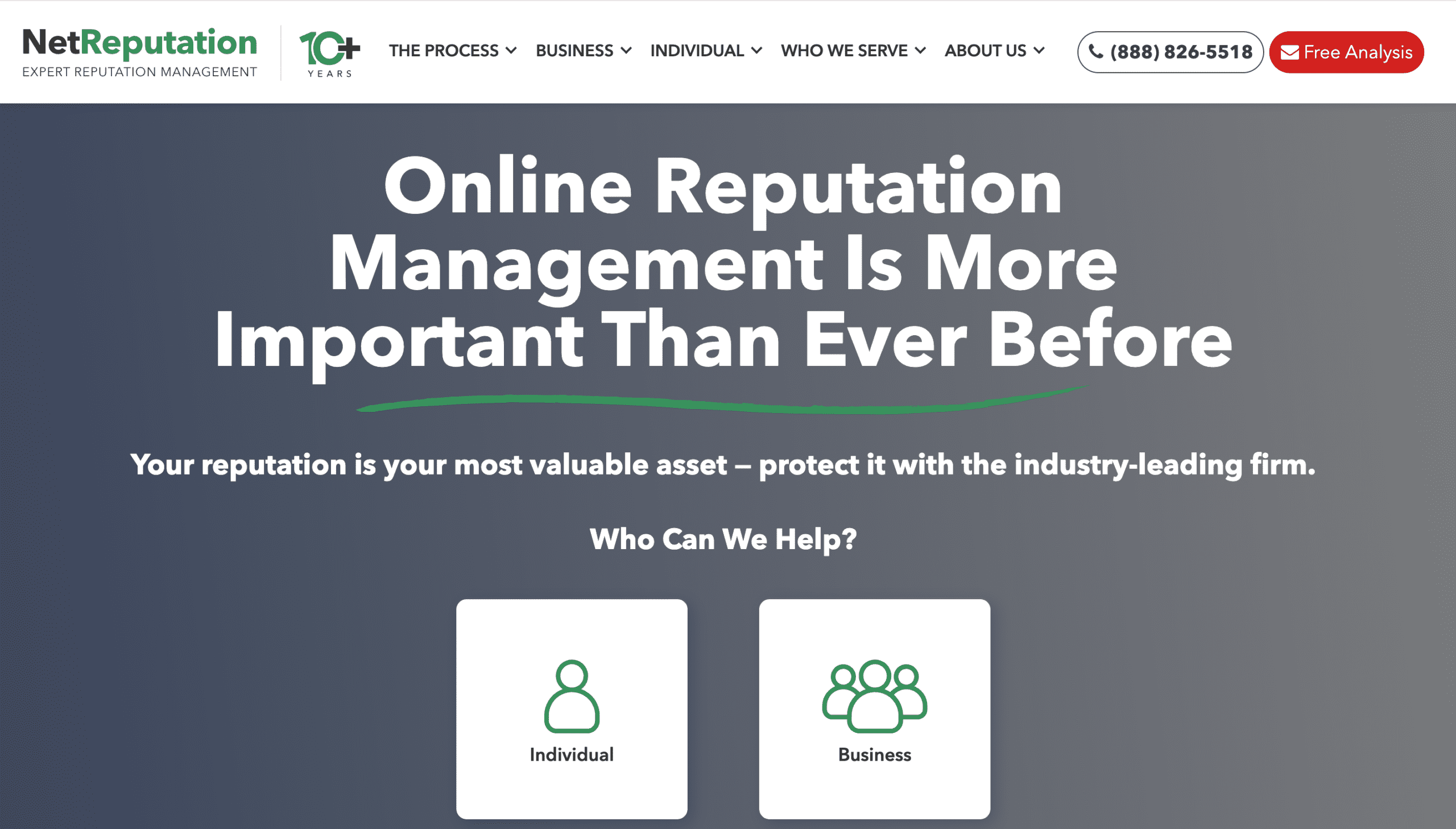
NetReputation is America’s largest full-service online reputation management firm, serving both businesses and individuals since 2015. The company has helped thousands of clients, including:
Business Owners: When outdated and misleading content was causing reputational challenges for a business owner, NetReputation fixed the problem within a few months. Eight negative links were displaced from Google’s first two results pages, replaced with over 30 positive results.
Real Estate Professionals: Within six months, NetReputation displaced negative search results that were misrepresenting a real estate professional’s reputation. They were moved off Google’s first two SERPs and replaced with positive brand assets.
Sales Representatives: NetReputation helped a sales rep whose professional growth was hindered after harmful results appeared online. In less than 1 year, NetReputation suppressed negative links to the second page of Google and replaced them with brand assets.
NetReputation has been recognized by Newsweek as a top resource and it’s among Inc.’s 5000 companies, honoring the U.S.’s fastest-growing brands. They also have an 4.7 “Excellent” rating on Trustpilot and five stars on Clutch. Overall, reviewers have had an excellent experience working with NetReputation, specifically highlighting the helpfulness of its experts and the time they take to answer client questions.
2. Reputation X: Best for Wikipedia Editing
 #2 of 11
Reputation X
Best for: Wikipedia editing & SERP curation for established brands
Core services
-
Wikipedia article research & maintenance
- SERP suppression
-
 Earned-media outreach
-
 Multilingual content
What sets them apart
A dedicated Wikipedia editing unit that works within Wikipedia's neutral-point-of-view rules, with multilingual capacity for global rollouts.
Watch for: Enterprise-level pricing on the specialist Wikipedia layer; not the right fit for SMBs who mainly need review management.
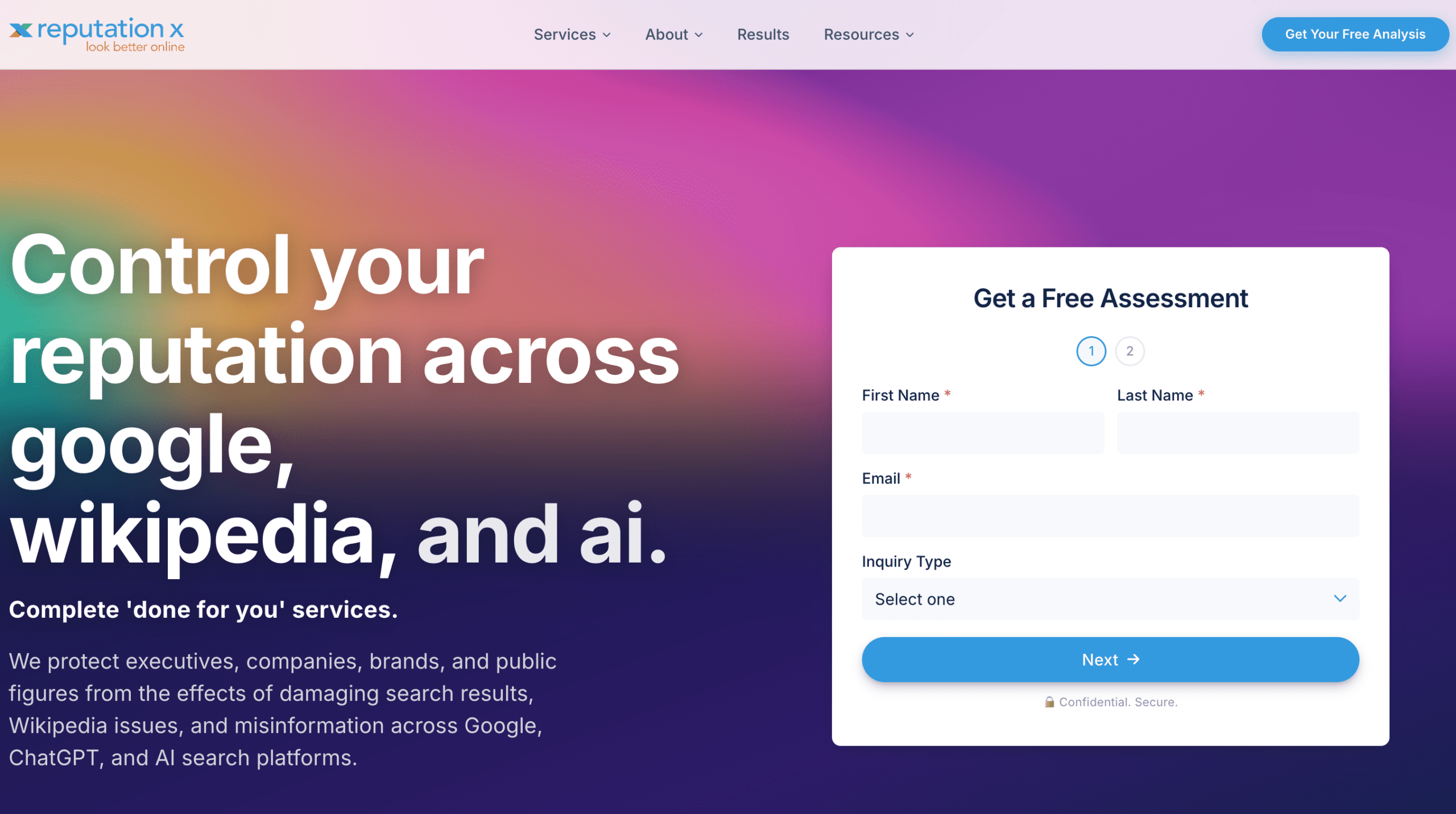
Reputation X is a boutique firm focused on high-authority search results for established brands and global organizations. Its calling card is Wikipedia research and maintenance, SERP architecture, and earned-media outreach, with FAQ-style transparency about what it will and won’t promise.
3. Status Labs: Best for Crisis PR
 #3 of 11

Status Labs
Best for: Crisis PR & public-figure ORM
Core services
-
Crisis response
-
 Executive reputation management
-
 Digital strategy
-
PR coordination
-
Global incident management
What sets them apart
Blends digital ORM with traditional crisis PR, including international incident handling.
Watch for: Premium pricing aligned to crisis engagements; not optimized for steady-state SMB review management.
Status Labs is an Austin-headquartered reputation and crisis-communications agency serving executives, public figures, and global brands. It pairs online reputation management with conventional PR to steer narratives through high-stakes events, operating from offices across the US and Europe.
4. Reputation Defender: Best for Personal Data Removal and Privacy Protection
 #4 of 11
Reputation Defender
Best for: Executive privacy & individual search cleanup
Core services
-
 Personal information removal
-
Privacy tools
-
 Dashboard search monitoring
-
Light suppression
What sets them apart
The category's original consumer ORM brand, now automated and privacy-first, backed by Gen Digital (Norton / LifeLock / Avast).
Watch for: More automated and dashboard-driven than full-service; less hands-on for complex executive cases.
Reputation Defender pioneered consumer online reputation management in 2006 and is now a Cyber Safety product inside publicly traded Gen Digital (Norton’s parent). It focuses on personal search cleanup, data-broker removal, and monitoring for individuals via automated tooling.
5. BrandYourself: Best for DIY Personal Reputation
 #5 of 11

BrandYourself
Best for: DIY personal reputation tools
Core services
-
Personal search audit
-
Content suppression
-
 Social listening
-
 Sentiment tracking
-
 Optional managed services
What sets them apart
A self-serve software model that's accessible to individuals who can't commit to a full-service agency engagement.
Watch for: DIY platforms have a ceiling on severe defamation, mugshot cases, and multi-jurisdictional removals.
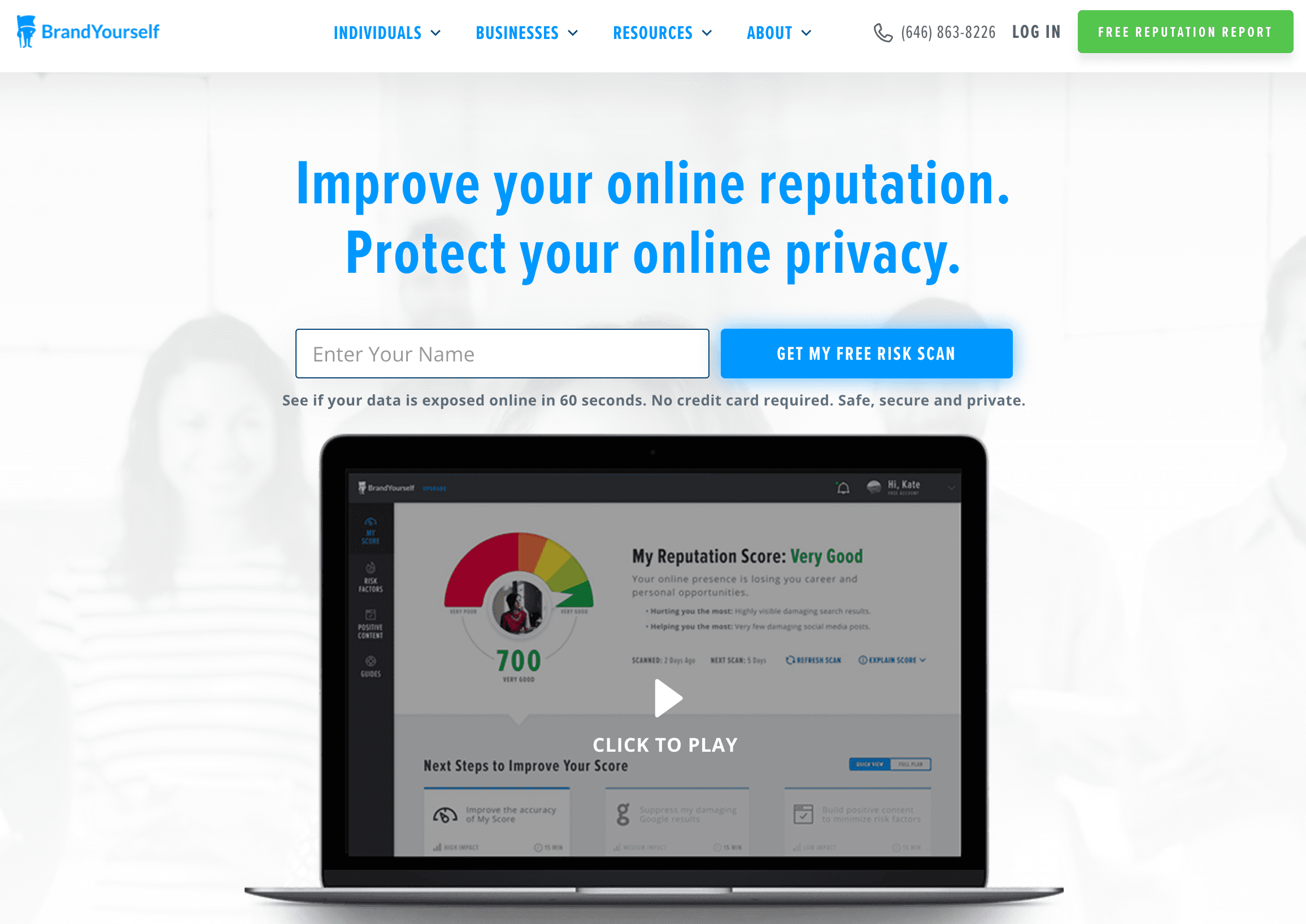
BrandYourself is a New York–based DIY reputation and privacy platform (also known as HelloPrivacy) with optional concierge support. Its freemium tools help individuals and businesses audit their search presence, suppress negative content, and remove personal data from broker sites.
6. Birdeye: Best for Multi-Location Review Management
 #6 of 11

Birdeye
Best for: Multi-location review & listings management
Core services
-
AI-assisted review collection & response
-
 Social media management
-
 Listings management across 200+ sites
-
Search AI / LLM visibility
What sets them apart
Built-in AI agents for reviews, social, and listings plus LLM-visibility tracking, connecting to 3,000+ CRMs.
Watch for: Platform-led; less hands-on for one-off content removal or crisis response.
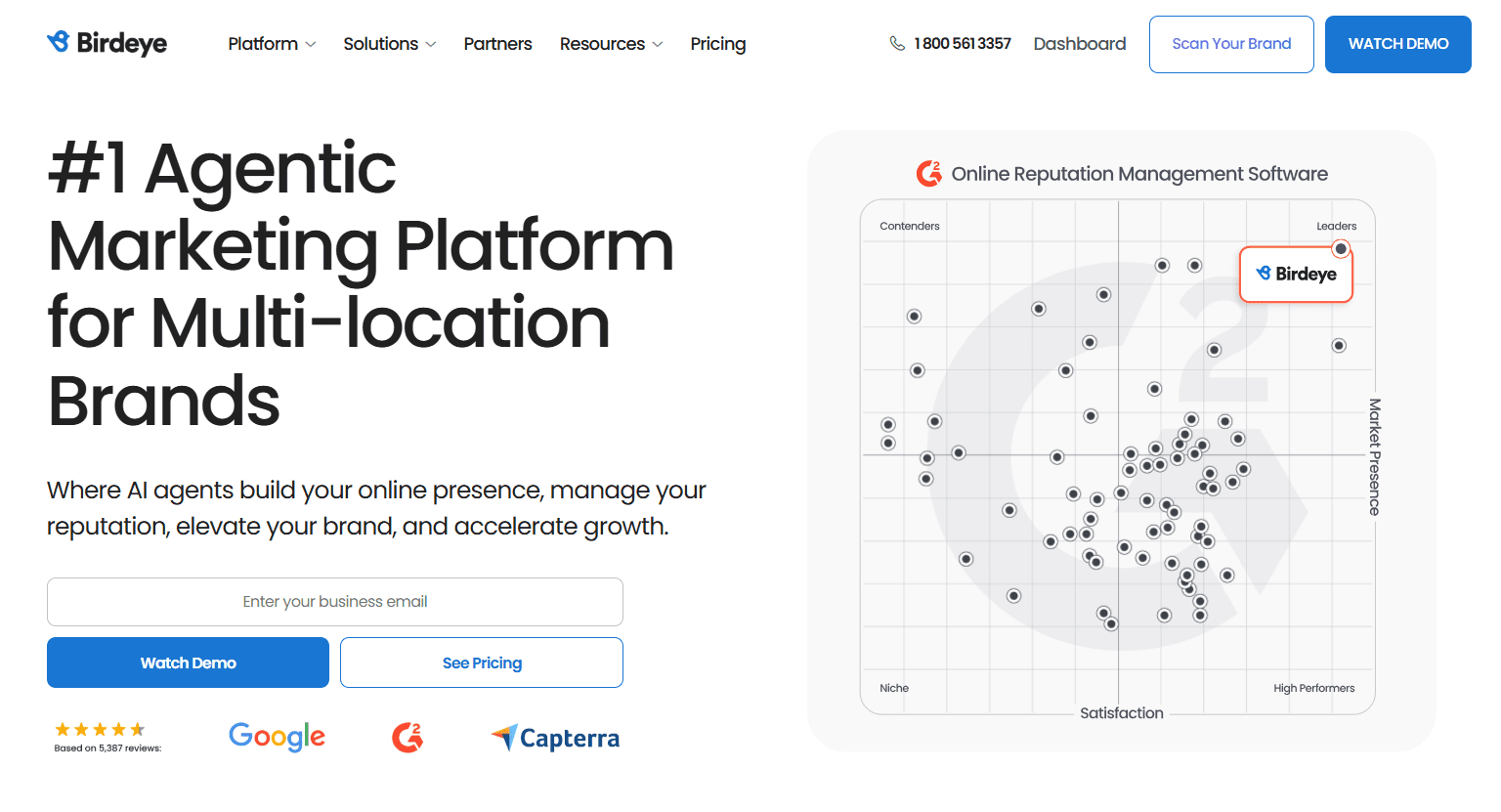
Birdeye is an enterprise-grade reputation and AI marketing platform used by 200,000+ businesses. From a single dashboard, brands collect, monitor, and respond to reviews across 200+ sites, manage listings and social, and track visibility inside AI assistants like ChatGPT, Gemini, and Perplexity.
7. Reputation.com (Reputation): Best for Enterprise Review Programs
 #7 of 11
Reputation.com (Reputation)
Best for: Enterprise review programs at scale
Core services
-
Review monitoring
-
 CX surveys
-
Location-level analytics
-
Social listening
-
Reporting dashboards
What sets them apart
Multi-location reporting and scoring infrastructure (Reputation Score X) built for franchises and chains.
Watch for: Designed for review-led ORM; less focused on content removal or executive search cleanup.
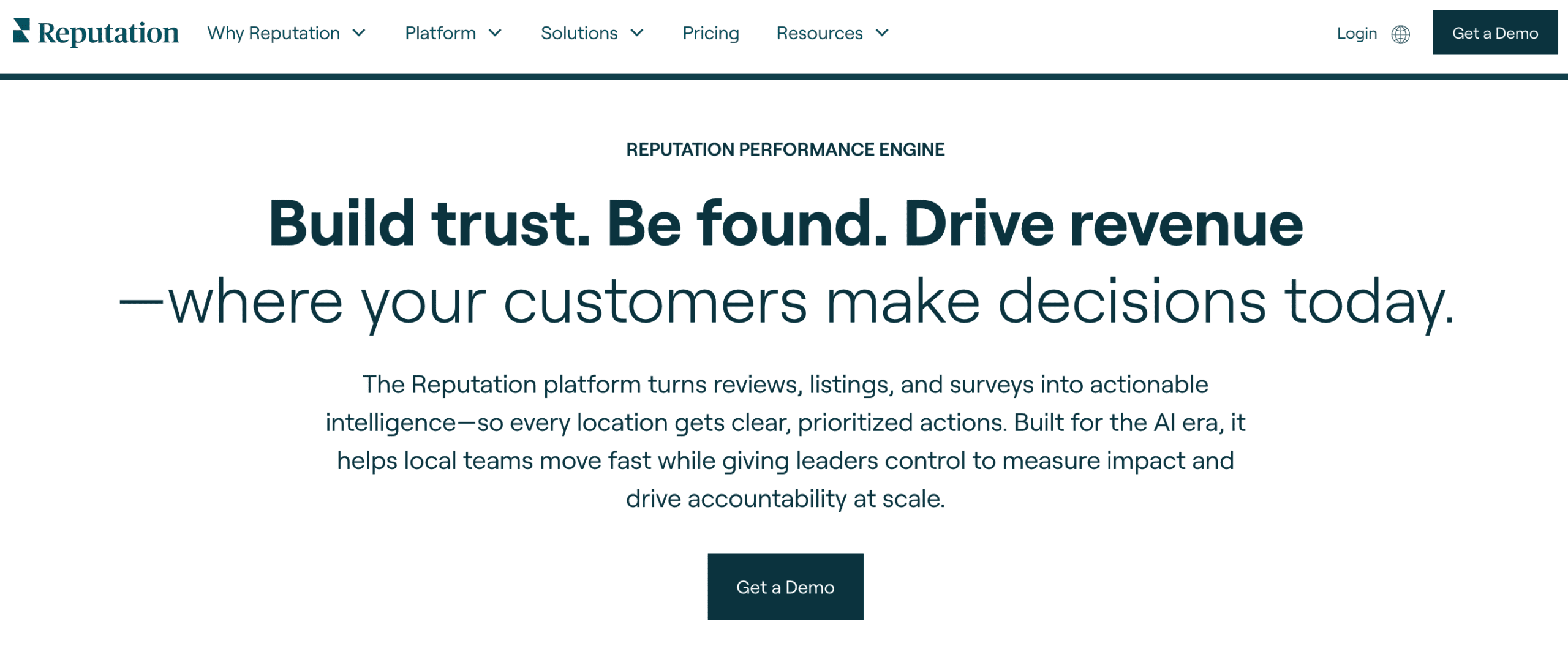
Reputation is an enterprise reputation and customer-experience management platform for large, multi-location organizations. It centralizes review monitoring, surveys, social listening, and location-level analytics, and created the “Reputation Experience Management” category with its patented scoring.
8. Podium: Best for Local Business & SMS Review Generation
 #8 of 11
Podium
Best for: SMS-driven review generation for SMBs
Core services
-
Text-based review invitations
-
 Customer messaging
-
 Payments integration
-
Webchat
What sets them apart
Text-message review collection that drives unusually high response rates from local-business customers.
Watch for: Optimized for review acquisition and customer messaging — not a full-service ORM firm.
Podium is a Lehi, Utah SMS-first customer communication and review platform for local businesses. It helps SMBs collect reviews, message customers, take payments, and convert leads from one inbox, and has expanded into AI-powered lead management.
9. WebiMax: Best for SMBs Bundling ORM with Marketing
 #9 of 11
WebiMax
Best for: SMBs bundling ORM with broader marketing
Core services
-
ORM
-
SEO
-
 Paid media
-
Web design
-
Social media
-
 Lead generation
What sets them apart
Reputation management delivered alongside the full marketing stack — useful for SMBs that want one vendor for everything.
Watch for: ORM is one of many services; ORM-specialist firms may go deeper on complex suppression or crisis work.
WebiMax is a New Jersey full-service digital marketing agency where reputation management is one of its longest-running practice lines, sitting alongside SEO, paid search, PR, and web design. It positions itself as a strategic partner for small-to-medium businesses.
10. Igniyte: Best for International ORM
 #10 of 11
Igniyte
Best for: UK & international ORM, legally complex cases
Core services
-
Search result management
-
Content removal
-
Crisis communications
-
 Online defamation support
-
Executive ORM
What sets them apart
Strong UK and European presence with hands-on experience navigating GDPR and Right-to-be-Forgotten requests.
Watch for: UK-centric operating model; US-based clients should confirm engagement structure and time-zone coverage.
Igniyte is a UK-based online reputation and reputation-risk consultancy retained for legal and complex cases across Europe, the Middle East, and North America. It blends strategic communications, digital PR, SEO, and legal support to protect and repair reputations for brands, executives, and high-net-worth individuals.
11. Thrive Internet Marketing Agency: Best for Multi-Industry Digital Marketing With ORM
 #11 of 11
Thrive Internet Marketing Agency
Best for: ORM combined with broader digital marketing
Core services
-
Review generation
-
Listings management
-
Brand sentiment analysis
-
PR crisis response
-
SEO & local SEO
What sets them apart
Pay-for-performance model on selected services, backed by a proprietary reporting suite.
Watch for: ORM is bundled into a broader agency offering — not an ORM-specialist firm.
Thrive is an Arlington, Texas performance-focused digital marketing agency that folds reputation management into wider SEO and customer-acquisition work. It emphasizes measurable results and transparent reporting across review generation, listings, sentiment analysis, and crisis PR.
ORM Company Comparison Table
Below is a quick-reference view of the top 12 ORM companies and firms in 2026. The right ORM firm for your project depends on your specific situation, so the “best for” column should drive selection more than alphabetical or numbered position.
| Company | Best For | Core Focus | Audience | Year Founded |
|---|---|---|---|---|
| NetReputation | Full-service B2B and B2C reputation campaigns | Full-service ORM (removal, suppression, SEO, crisis management, privacy) | B2B and B2C | 2014 |
| Reputation X | Wikipedia editing and SERP curation for established brands | Full-service ORM (removal, suppression, SEO-driven reputation repair, crisis management) | B2B and B2C | 2005 |
| Status Labs | Crisis PR and public-figure ORM | Full-service ORM (reputation repair, PR, suppression, SEO, crisis management) | B2B and B2C | 2012 |
| Reputation Defender | Executive privacy and individual search cleanup | Privacy and removal (personal data removal, suppression, identity protection) | Primarily B2C | 2006 |
| BrandYourself | DIY personal reputation tools | DIY protection, suppression and personal branding tools | Primarily B2C | 2010 |
| Birdeye | Multi-location review and listings management | Reviews, customer experience and listings management | B2B | 2012 |
| Reputation.com | Enterprise review programs at scale | Enterprise reputation and customer experience management | B2B | 2006 |
| Podium | SMS-driven review generation for SMBs | Reviews, messaging, customer communication, payments | B2B | 2014 |
| WebiMax | SMBs bundling ORM with broader marketing | Full-service digital marketing and reputation management | B2B and B2C | 2008 |
| Igniyte | UK and international ORM, legally complex cases | Enterprise reputation management, SEO suppression, corporate PR, crisis management | B2B | 2009 |
| Thrive Internet Marketing Agency | ORM combined with broader digital marketing | Full-service digital marketing and reputation review/management | B2B and B2C | 2005 |
How to Choose the Best ORM Company for Your Needs
As a business owner, your brand’s online reputation is one of your most valuable and intangible assets. Here are some tips for helping you choose the best online reputation management company for your needs.
Step 1: Identify Your Business’s Reputation Management Needs
Identifying your business’s reputation management needs involves a few steps, including understanding your current reputation, identifying areas for improvement and aligning those needs with your overall business goals. Here’s what to do:
- Assess Your Current Online Reputation: Start by searching for your business online, using search engines, social media, review sites and other platforms where customers may leave feedback. Evaluate the sentiment of the reviews and comments you find. Also, check your business’ visibility on search engines.
- Analyze Customer Feedback: Regularly read and analyze the feedback from your customers. Are there recurring issues or complaints? Are customers praising a particular aspect of your business? Trustpilot found that more than 93% of online shoppers read reviews before making an online purchase and reviews matter more to customers than pricing and discounts.
- Monitor Social Media: Social media platforms can be a source of informal feedback. Monitor your business’ mentions and hashtags to understand public perception.
- Competitor Analysis: Look at your competitors. How do their online reputations compare to yours? What can you learn from their successes or failures?
- Identify Your Goals: What do you hope to achieve with improved reputation management? This could be anything from better brand awareness or increased customer trust to improved star ratings on review sites or a more robust crisis management plan.
- Look for Gaps: Where are the gaps in your current reputation management strategy? Do you struggle to respond to negative reviews, lack a proactive approach, or need better tools to monitor your online reputation?
- Consider Your Resources: Assess your current resources. Will you need to outsource these tasks to a reputation management service? Make sure to consider the use of AI overviews in Google results, too. Today, 52% of sources mentioned by Google AI overviews rank in the top 10 search results.
Step 2: Research the Reputation Management Firm and Read Reviews

With the list of best reputation management companies in mind, begin your research by evaluating how customers view candidates. Reviews can reveal a lot about a reputation management company, like:
- Quality of service
- Timeframes of reputation management campaigns
- Variety of services, including online listening and social media marketing
- Personalization/customization of services
- Presence or absence of long-term contracts and payment plans
- Results delivered and whether or not results met client expectations
Take the time to research each candidate carefully before agreeing to sign a contract. Sprout Social found that 76% of customers take notice of and appreciate it when companies prioritize support.
Step 3: Evaluate the Reputation Management Firm’s Expertise and Experience

Evaluating a reputation management company’s expertise involves several steps. Investigate their track record, understand their methods and ascertain the quality of their customer service.
- Check Their Track Record: Look at the history of the reputation management company and see what kinds of clients they’ve worked with. Have they handled businesses similar to yours and in your industry? A good track record with a variety of clients indicates adaptability and experience.
- Read Reviews and Case Studies: Look for online reviews and read case studies on their website. Pay particular attention to how they’ve handled challenging situations and what outcomes they’ve achieved.
- Understand Their Approach: The company should use ethical, white-hat methods for reputation management. Avoid companies that promise quick fixes or use dubious tactics, as these can damage your reputation in the long run.
- Consider Their Expertise: Evaluate their knowledge in ORM, such as SEO, social media marketing, review management, PR, content creation and crisis management. A company with a broad range of skills can offer a more comprehensive strategy.
- Assess Their Tools and Technology: Find out what tools they use to manage your online reputation. The company should use modern, sophisticated reputation management software to track changes in your online reputation and react promptly.
- Quality of Customer Service: Good customer service is crucial. You should feel confident that the company will be responsive and communicative. Ask them about their process for updating clients and handling issues that arise.
- Request a Consultation: The best reputation management companies will offer a free consultation. This can give you a sense of their expertise and whether they understand your specific needs.
Remember, the best reputation management company for you will align with your needs, understand your business and use ethical strategies to protect your online reputation.
Step 4: Assess Pricing and Value Proposition

Assessing the pricing and value proposition of an online reputation management company requires understanding its service offerings and aligning them with your business needs. Here are a few steps to guide you:
- Understand Their Services: Firstly, gain a clear understanding of the services the company offers. Do they provide review management, social media management, SEO, content creation, PR, or other services? Make sure they offer the specific services your business needs.
- Review Their Pricing Structure: Examine how the company structures its pricing. Is it a monthly or yearly subscription, or do they charge per service? Are there additional costs that aren’t included in the base price? Remember, the cheapest option may not always provide the best value.
- Compare Value Propositions: Look at what each company offers in relation to its cost. Consider both tangible offerings (reputation management software and tools, reports) and intangible offerings (expertise, customer service).
- Check Scalability: As your business grows, your reputation management needs might change. Does the company offer packages that can scale with your business?
- Assess ROI: Consider the potential return on investment. A good reputation management service can help improve your online presence, attract more customers and ultimately increase sales, outweighing its cost.
- Look at the Contract Terms: Is there a long-term contract, or can you cancel at any time? Make sure the terms are flexible enough to suit your business needs.
- Ask for a Custom Quote: If the company’s packages don’t exactly match your needs, ask for a custom quote. This will ensure you’re not paying for services you don’t need.
By taking these steps, you can better assess whether a reputation management company’s pricing and value proposition align with your budget and requirements. Keep in mind that effective reputation management can be a significant investment, but the benefits to your brand can be substantial.
Step 5: Meet With Several ORM Companies and Make Your Final Decision

Once you’ve completed your due diligence on candidates for your online reputation management needs, it’s time to complete the selection process by meeting with your best choices. During the meeting, consider the following:
- Understanding of Your Needs: The company should demonstrate a clear understanding of your business, your industry and the specific reputation challenges you face. They should also be able to provide clear solutions tailored to your unique needs.
- Strategic Approach: Ask about their strategy for managing and improving your online reputation. The approach should be comprehensive, ethical and aligned with your business objectives. Be wary of quick fixes or promises that seem too good to be true.
- Transparency: The company should be open about its methods and the reputation management software it uses. The representative should also provide regular reports showing their progress and the current state of your online reputation.
- Services and Pricing: Ensure you fully understand the services included in their packages and the associated pricing. Ask whether they offer any guarantees or refund policies.
- Customer Service: Pay attention to their communication style and responsiveness. The best reputation management companies will provide excellent customer service, keeping you informed and quickly addressing any concerns.
Remember, the goal of the meeting is to ensure that the company is not only capable of managing and improving your online reputation but also a good fit with your business’s culture and values. Don’t be afraid to ask questions and make sure all your concerns are addressed.
Step 6: Confirm Their AI Overview and GEO Capabilities

Before selecting an ORM partner, confirm whether the company is actively optimizing for visibility in AI-driven discovery environments, not just traditional search. Ask specifically if the firm will track how your brand appears in AI Overviews, ChatGPT, Perplexity and Google Gemini responses.
Many ORM providers still focus primarily on classic SEO metrics, which no longer reflect how users actually find information. You should also ask whether they offer a defined generative engine optimization (GEO) methodology or if GEO is simply being layered onto existing SEO practices.
A credible provider should be able to explain how they structure content, authority signals and brand mentions to influence generative model outputs. If they cannot clearly articulate a GEO framework or measurement approach, it may indicate they are not fully aligned with how search visibility is evolving.
Red Flags: How to Spot a Bad ORM Firm
A low-quality ORM firm is usually easy to spot by a few consistent warning signs. Look out for companies that guarantee specific SERP rankings or removal outcomes, rely on vague “proprietary methods” that they won’t define or lack transparency around pricing, strategy or timelines.
Here are a few of the main red flags to be aware of as you research the best ORM firm for your needs.
- Guaranteed removal of any Google result. Google does not work that way for most content types. Source removal can be negotiated, search-engine de-indexing applies in narrow legal frameworks like GDPR and most cases require suppression rather than removal.
- Fake review generation. The FTC’s final rule (effective October 21, 2024) explicitly prohibits the creation, sale and procurement of fake consumer reviews and testimonials, including AI-generated reviews. A firm offering review generation services should be a hard no.
- No verifiable office, no named team, white-labeled offshore work. We recommend verifying the firm’s physical office address and looking for named ORM staff on LinkedIn.
- Refusal to transfer ownership of digital assets at end of contract. Domains, profiles and content created during the engagement should belong to the client at termination.
- Vague reporting with no measurable KPIs. A real ORM firm reports on suppressed URLs, displaced negative results, review-rating movement and AI-citation share.
ORM for Executives vs. ORM for Businesses
Executive ORM and business ORM use many of the same underlying strategies including search optimization, content creation and reputation monitoring, but they are built to solve very different problems.
| Dimension | Executive ORM | Business ORM |
|---|---|---|
| What it protects | Executive ORM protects the visibility of an individual leader. Personal search results, media coverage and social perception directly impact credibility and career risk. | Business ORM protects brand equity at scale. It manages customer reviews, corporate search presence and broader market trust across multiple stakeholders and channels. |
| Core emphasis | Discretion, Knowledge Panel optimization and personal-brand SEO across high-search-volume name queries, AI Overview defense for the executive’s name, and professional bio standardization across press and authority sites. | Multi-location review management, listings consistency, crisis response infrastructure, employee-generated content risk monitoring and brand-name SERP control. |
Some firms specialize in one type of ORM over another. For instance, Status Labs leans toward Executive ORM while Birdeye leans toward Business ORM and Reputation X serves both audiences through different teams. Other firms, including NetReputation, handle both as parts of a single full-service offering.
AI Overviews, ChatGPT and the New ORM Frontier
Traditional SERP suppression no longer captures the full reputation surface area. Today, AI Overviews, ChatGPT, Perplexity and Gemini generate brand summaries that pull from a different and broader source set.
Traditional blue-link SERP suppression alone is no longer sufficient because AI Overviews and LLM answer panels surface sources that may not appear in the top 10 organic results.
AI Overviews differ from the SERP because they synthesize across sources including news articles, Reddit threads, Wikipedia and forum discussions, often surfacing older or more critical content than the user might find on page one.
This means reputation management is no longer about ranking or de-ranking links. It’s about shaping which sources are considered authoritative by AI systems that summarize the web in real time.
As a result, ORM strategies now require continuous monitoring of how a brand is represented inside generative answers, not just traditional search listings.
In your research, be sure to ask each prospective ORM firm about generative engine optimization (GEO), including questions like:
- Do they track brand mentions in ChatGPT, Gemini, Perplexity?
- Do they have a methodology for influencing AI Overview citation?
- Are they tracking brand share of voice in generative answers?
Check out our recent article for more information on how AI is transforming reputation management and what forward-thinking individuals and companies need to prioritize in 2026 and beyond.
Frequently Asked Questions
Is online reputation management the same as SEO?
Although online reputation management (ORM) and search engine optimization (SEO) often work in tandem, overlapping in some areas and complementing each other, they are not the same.
SEO is the practice of optimizing a website to rank higher in search engine results pages (SERPs) for specific keywords. It involves various techniques such as keyword optimization, quality content creation, backlinking and technical website optimizations. The primary goal of SEO is to increase organic traffic to a website.
On the other hand, ORM is a broader concept focused on managing the public perception of an entity (a person or an organization) on the internet. This involves monitoring and influencing the digital reputation of the entity. It not only encompasses SEO techniques to promote positive content but also includes managing reviews and ratings, responding to customer queries on review sites and social media, handling negative content and crisis management.
How much does it cost to clean up an online reputation?
The cost to clean up an online reputation can vary greatly depending on the complexity of the situation, the size of the company, the scope of the work involved and the reputation management service provider you choose.
Some companies might charge a one-time fee for certain services, like removing specific unwanted content, while others may offer subscription-based packages that provide ongoing reputation management and monitoring services.
Remember, the best reputation management strategy is a proactive one. Investing in ongoing reputation management can help prevent reputation issues before they arise, which can be more cost-effective in the long run.
However, costs can change over time and vary between different service providers, so it’s always best to get quotes from several companies to understand current rates. Remember to consider not just the cost but also the value and ROI the service can provide.
How long does online reputation management take?
The length of time required for online reputation management can vary significantly based on several factors, including the scope of the situation, the strategies implemented and the severity of any damage to the online reputation.
For minor issues, such as a few negative reviews or comments, a reputation management campaign might start seeing positive results in a matter of weeks or a few months. In some limited cases, positive results may begin to appear in days but typically take a bit longer. However, for more severe or widespread reputation issues, it might take several months or even years to effectively repair and rebuild an online reputation.
What is the best ORM company for small businesses?
For small businesses, the best ORM company depends on whether you need full-service reputation repair or primarily review management. NetReputation is often a strong fit for SMBs that want a full-service approach that covers suppression, search visibility and ongoing monitoring. Businesses focused mainly on review generation and customer feedback workflows may also consider Podium or Birdeye. SMBs looking to combine ORM with broader digital marketing services sometimes evaluate WebiMax.
What is the best ORM firm for executives?
For executives, the best ORM firm depends on whether the individual needs proactive personal brand management or active reputation defense. NetReputation is often chosen for full-service executive ORM with discretion and long-term visibility control. Status Labs is commonly used by executives who are navigating active crises or high-profile media exposure. Reputation X is frequently selected for cases where Wikipedia presence and knowledge panel issues are central.
Can an ORM company guarantee to remove negative Google results?
No. An ORM company should not guarantee the removal of negative Google results. True removal is only possible in limited situations, such as when content is taken down at the source, when legal frameworks like GDPR support de-indexing, or when DMCA takedown requests for copyrighted material occur.
In most cases, ORM focuses on suppression and visibility management rather than content deletion. This is why we list “guaranteed removal” as a major red flag for ORM firm evaluation.
What is the difference between an ORM firm and a PR agency?
PR agencies primarily focus on shaping public perception through media coverage, press releases and storytelling and establishing relationships with journalists and respected news outlets.
ORM firms focus on controlling what appears in search results, managing reviews and influencing AI-generated brand summaries. While both disciplines overlap in some areas including crisis management and authority-building content creation, they optimize for different visibility channels and outcomes. NetReputation operates at the intersection of these services with our PR services line.
What Our Clients Say
“We had three negative news articles ranking on the first page of Google for our company name. Within four months, NetReputation had pushed them off page one entirely. Our sales pipeline recovered almost immediately. I wish we had called them sooner.”
“We operate 47 franchise locations and reputation management was a constant headache. NetReputation built a scalable system that monitors and responds to reviews across all our locations automatically. Our average rating went from 3.8 to 4.7 in six months.”
“A former employee launched a coordinated smear campaign against us online. NetReputation's crisis team responded within 24 hours, had a counter-strategy in place by day three, and within 90 days the damaging content was buried. Their speed and expertise saved our company.”
 800-200-3000
 Rated #1 by Newsweek