 800-200-3000
Is Wikipedia Reliable? The Truth About Its Credibility
Wikipedia plays a major role in online reputation management, as its pages often rank highly in search results and can strongly shape public perception of individuals and organizations. It’s one of the most widely used online reference sources, but its reliability can vary from one article to the next.
Is Wikipedia reliable? Research shows that many articles are highly accurate, especially in well-monitored topics, but issues like bias, uneven sourcing and vandalism do exist. Understanding how these issues occur and ways to navigate them can help you control your online reputation, assess credibility and make more informed decisions about the information you trust.
Key Takeaways
- Wikipedia is a useful starting point for research, but should not be treated as a final or authoritative source.
- Studies have found that many Wikipedia articles are surprisingly accurate. A widely-cited 2005 study in Nature found that Wikipedia’s science articles came close to the accuracy of Encyclopedia Britannica, while later research published in the Reference Services Review estimated the site’s overall accuracy at around 80%.
- Wikipedia’s biggest strength is open editing, which is also its biggest weakness. Anyone can edit most articles and editors are not required to show credentials or prove expertise.
- The most reliable Wikipedia pages usually show clear signs of active oversight like strong citation density, frequent edits by multiple contributors, detailed Talk Page discussions and warnings when content is disputed or underdeveloped.
- When inaccurate or misleading Wikipedia information affects an individual or organization, professional editors can propose corrections while following the site’s strict conflict-of-interest and disclosure guidelines.
What Is Wikipedia and How Does It Work?
Wikipedia is a free, multilingual online encyclopedia owned by the nonprofit Wikimedia Foundation. The content on this site is written and edited by volunteers, with no formal editorial board.
Wikipedia was founded by Jimmy Wales and Larry Sanger and launched on January 15, 2001. It is owned by the Wikimedia Foundation, a 501(c)(3) nonprofit based in San Francisco, funded primarily by donations.
Wondering how to create a Wikipedia page? Anyone with an internet connection can create a Wikipedia account and edit most articles, though some pages are protected. Articles are written and updated by volunteer editors (“Wikipedians”) who are not credentialed by Wikipedia.
Wikipedia operates under “Five Pillars,” including:
- Wikipedia is designed to function. It is not a platform for self-promotion, advertising, social media or opinion pieces.
- Articles are written from a neutral point of view and supported by reliable sources.
- Wikipedia is published under a free license, so anyone can use, edit or distribute the content.
- Editors are encouraged to collaborate respectfully and show civility during discussions and disputes.
- Wikipedia’s rules and guidelines evolve over time and editors have flexibility over how articles are improved and maintained.
The English Wikipedia features more than seven million articles and has 52.9 million registered users. The active editor community includes around 276,000 active contributors who make edits monthly.
Because Wikipedia is constantly updated, article quality can vary significantly from one page to another. Some entries are extensively sourced and monitored by experienced editors while others may contain outdated information or unsupported claims. This transparency is one of Wikipedia’s defining strengths but it means users must critically evaluate all content rather than assume every article meets the same standard.
Is Wikipedia a Reliable Source?
Can Wikipedia be trusted? The answer is conditional. Wikipedia is generally reliable enough for orientation and identifying sources when conducting general background research. However, it should not be used as an exclusive, authoritative source for high-stakes work, including academic citations or critical decision-making.
The site’s unreliability stems from the fact that anyone can edit Wikipedia articles and there isn’t a formal expert review process in place. This is why most academic institutions discourage citing Wikipedia as a primary source.
Studies comparing Wikipedia to traditional encyclopedias have repeatedly found accuracy in the same general range. However, reliability varies dramatically across articles. A 2005 study in Nature (Giles) found that science articles on Wikipedia averaged about four inaccuracies per entry compared to about three in Britannica. In 2008, a study by Reference Services Review estimated Wikipedia’s accuracy at about 80% compared to around 95% to 96% for traditional encyclopedias.
While these figures are useful, they’re also a historical snapshot of a rapidly revolving platform. Reliability is not uniform across Wikipedia. High-traffic articles on major scientific topics or widely-covered current events are typically well-cited and heavily edited while low-visibility or niche pages may go without review for an extended period of time. Articles on these pages may contain outdated or unverified information.
Wikipedia acknowledges these limitations in its reliability guidance. The site notes that content quality can vary by topic and stresses that users should evaluate sourcing and editorial history rather than assume uniform accuracy across pages.
How Does Wikipedia Ensure Accuracy?
Wikipedia uses four core mechanisms to help ensure its pages are as accurate as possible. These include a comprehensive volunteer editor review, strict citation requirements, discussion and consensus-building on Talk Pages and varying levels of page protection for sensitive or frequently-edited articles.
While these are helpful resources, they are not equivalent to professional fact-checking or a formal editorial review. The level of oversight on Wikipedia varies greatly depending on how actively a page is monitored and the visibility of the topic.
Wikipedia does not have professional fact-checkers and there is no editorial board. Instead, accuracy comes from these overlapping mechanisms:
- Verifiability policy: Every contested claim must cite a published reliable source.
- Reliable sources guideline: There are set established guidelines governing which sources count and which do not.
- Volunteer editor monitoring: There are guardrails in place, including watchlists, a designated Recent Changes Patrol and bots that revert obvious Wikipedia vandalism.
- Page protection levels: High-traffic or contested pages can be semi-protected or fully protected against editing.
Talk Pages are where editors debate sources, neutrality and disputed claims. The depth of a Talk Page can serve as a quality signal for readers.
However, when no editor is watching a particular article, errors can persist. From 2012 to 2022, one Wikipedia editor using the name Zhemao created more than 200 fake but highly detailed articles about medieval Russian history on Chinese Wikipedia. The articles were so convincing that some even received the site’s highest quality ratings before investigators discovered the entire article network was fictional.
More recently, Wikipedia has implemented bots like ClueBot NG that can automatically revert blatant vandalism, but they catch only the obvious cases. While Wikipedia remains a top resource for public collaboration, these limitations illustrate why the site should be considered a starting point for research instead of a final authority.
Why Wikipedia Has Credibility Concerns
There are four main concerns that make Wikipedia less credible than other websites when conducting high-stakes research. These include the site’s open editing format, the lack of a formal review process, the risk of article vandalism and the occurrence of bias and edit wars that often occur on pages.
These concerns affect different articles to different degrees, but they apply to pages across the website.
Open Editing Without Credential Checks
Wikipedia editors are not vetted for expertise and anonymous editing is permitted. Some may be subject matter experts on the topics they’re writing about, but many are not.
There’s also the issue of representation and a significant lack of diversity. Wikipedia editors tend to skew heavily male (87%) and are primarily white. This demographic imbalance contributes to systemic Wikipedia bias and can also create content gaps across the site.
No Formal Editorial Review Process
Unlike Britannica, Nature, or any other high-authority academic press, Wikipedia has no editor-in-chief and no pre-publication review. Once content is added, it stays in place until another editor challenges it.
Vandalism and Inaccurate Edits
Wikipedia defines vandalism as any page edits that are intentionally malicious, offensive or libelous. While bots like ClueBot NG will revert most blatant vandalism within minutes, they don’t catch all instances.
Sometimes, subtle factual edits and biographical falsehoods that look legitimate can slip through the cracks. One cultural reference is Stephen Colbert’s “Wikiality” segment from The Colbert Report. In 2006, Colbert coined the term “Wikiality” to describe a reality where a notion can become truth if enough people agree to it.
To test his theory, he challenged his viewers to flood Wikipedia’s current entry on African elephants, stating that the species’ population had tripled over the past six months. The changes stuck until Wikipedia administrators blocked Colbert’s IP address and locked down multiple elephant-related pages. This became an early reminder that while Wikipedia can correct misleading information quickly, its open-editing model still leaves room for inaccuracies and falsehoods to spread before they’re caught.
Bias and Edit Wars
Edit wars are repeated reverts between editors who disagree on content. These disagreements often emerge when underlying bias is present. In many cases, what appears to be an edit war is really a dispute over how a topic should be framed or which details deserve emphasis.
Commonly documented bias categories include:
- Gender bias
- Partisan or political bias
- Corporate bias
- Racial and ethnic bias
- Scientific dispute coverage
- Geographic bias
Partisan bias is one of the most studied concerns. A 2015 study by Shane Greenstein and Feng Zhu, originally published by Harvard Business School and summarized in Forbes, found that Wikipedia articles tend to lean more Democratic than comparable articles in Britannica. However, the researchers also found that heavily edited articles showed less bias over time, suggesting that sustained editing can help reduce partisan slant.
Wikipedia vs. Britannica vs. ChatGPT: Which Is More Reliable?
Comparing Wikipedia, Britannica and ChatGPT requires a consideration of context. Wikipedia is best for general orientation and source discovery, while Britannica is best for fact-checked, authoritative entries. This is because Britannica articles are commissioned from named domain experts, edited by professional staff and reviewed before publication. However, while this makes Britannica more reliable for individual factual entries, it can also limit its scope.
Wikipedia’s coverage breadth is far greater (more than 60 million articles across all languages compared to Britannica’s ~120,000 in English), but quality can vary from one article to the next.
ChatGPT and other AI assistants are useful for conversational drafting but users should verify the information they produce to ensure accuracy. ChatGPT and other LLMs do not retrieve from a fixed source. Instead, they generate plausible-sounding text from training data. This means they can fabricate citations, dates and quotes and should not be trusted as a sole source.
This phenomenon is called LLM hallucination. It occurs when an AI model generates factually incorrect or fabricated data and presents it confidently and fluently as fact. A 2024 study published in Nature found that LLMs can produce fluent but factually incorrect information with high confidence, highlighting the broader challenge of evaluating Wikipedia credibility in AI-generated information systems.
Here’s a quick recap of the primary question that each tool can help you answer:
- Wikipedia: What is X and where do I read more about it?
- Britannica: What is the authoritative summary of X?
- ChatGPT: How can I brainstorm ideas about X while still fact-checking for accuracy?
The chart below offers a high-level overview of these three resources:
| Source | Editorial Process | Best for | Watch out for |
|---|---|---|---|
| Wikipedia | Volunteer editors; verifiability policy; no editor-in-chief | Background research; finding cited sources | Niche or biographical articles with few editors |
| Brittanica | Commissioned experts; professional editorial review | Authoritative summary entries on established topics | Narrower scope; subscription required for deep access |
| ChatGPT / AI assistants | Generative model; no live retrieval | Conversational drafting, brainstorming | Fabricated citations, outdated training data, no source transparency |
How to Evaluate a Wikipedia Article
When using Wikipedia, you can evaluate online information in four steps. First, check the citation density and source quality. Second, review the article’s edit history. Third, read the Talk Page and fourth, look for expert or institutional involvement such as WikiProjects or quality badges.
For casual reading or quick orientation, the first step is usually sufficient. For academic work or any other high-stakes use, apply all four steps together to assess whether the article is stable, reliable, well-sourced and actively maintained.
Check Citation Density and Source Quality
A reliable Wikipedia article has frequent inline citations to academic journals, major news organizations, government sources and peer-reviewed publications. An unreliable one has sparse citations or cites blogs, advocacy sites, or unsourced web content. If you find a “citation needed” tag on an article, consider this a warning sign that the article has not been properly sourced and should not be read as fact.![A screenshot of a Wikipedia page for "Bioplastic" shows the introductory paragraph, with part highlighted and a blue “[citation needed]” label in brackets, enclosed in a red box—showcasing Wikipedia’s call for reliable sources.](https://www.netreputation.com/wp-content/uploads/wikipedia-citation-needed-tag-example-1024x576.webp)
Review the Article’s Edit History
Click the “View history” tab when you open a new article. Credibility features to look for include a long, active edit history and a high editor count. However, if you find that the article has been subjected to recent reverts and edit warring, proceed with caution. The same goes for an article that clearly shows bursts of edits from a single account.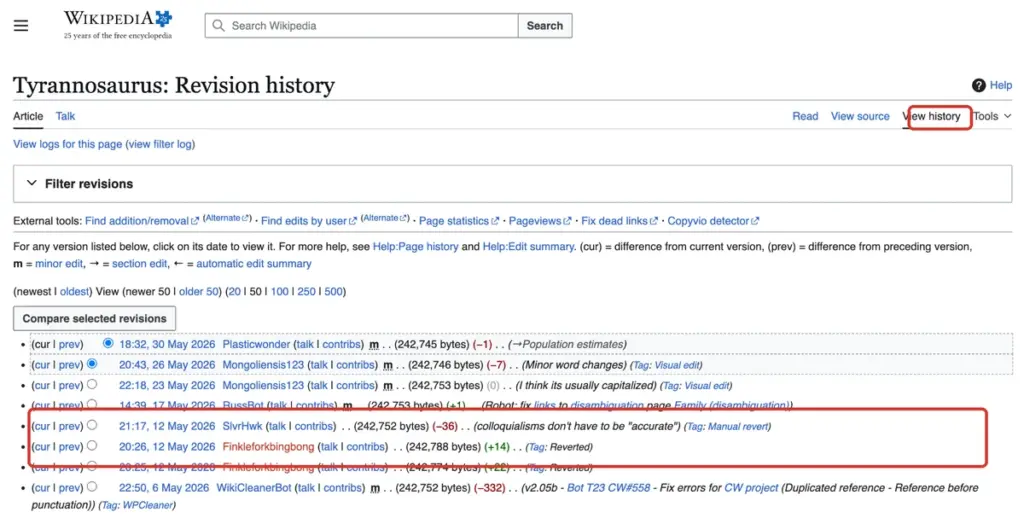
Read the Talk Page
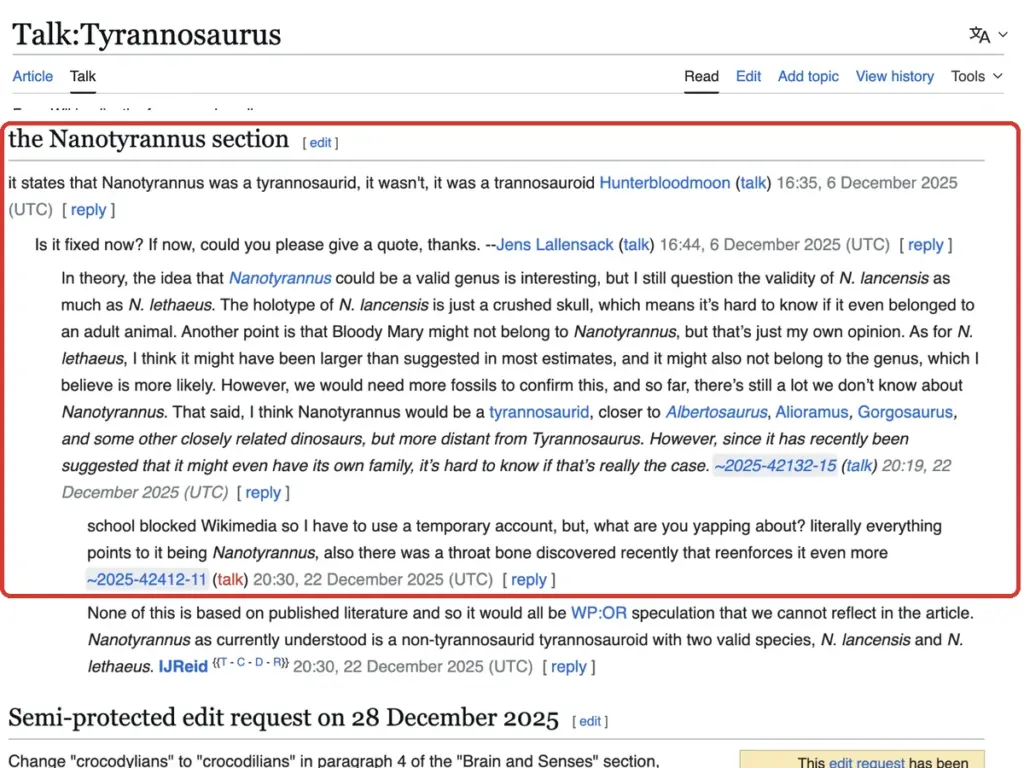
The “Talk” tab on each article shows the working debates among editors. A robust Talk Page with sourced disagreement is healthier than an article with no Talk Page activity. If the Talk Page is full of unresolved disputes about basic facts, treat the article as contested.
Look for Expert-Editor or Institutional Involvement
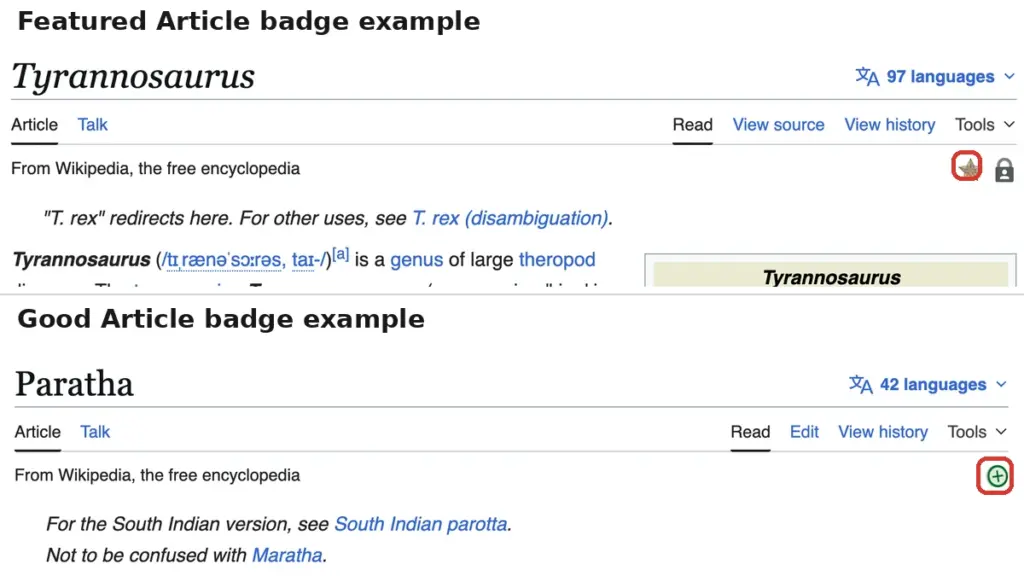
Some Wikipedia articles are maintained or monitored by WikiProjects, which are subject-matter groups of volunteer editors who coordinate improvements in specific topic areas. Articles that have been reviewed as “Good Articles” or “Featured Articles” have typically undergone a more rigorous internal review process.
These designations are not guarantees of perfection, but they are useful signals that an article has been evaluated for structure, sourcing and neutrality. In combination with citation quality, edit stability and Talk Page discussion, they help form a more complete picture of reliability when assessing Wikipedia as a research starting point rather than a final authority.
Wikipedia’s Efforts to Improve Credibility
Wikipedia’s credibility efforts center on three core policies: Verifiability, Neutral Point of View and No Original Research. These require that all material on the site be attributable and balanced, based on published sources rather than editor interpretation.
At the same time, partnerships with educational institutions and cultural organizations, such as Wiki Education and GLAM initiatives, have expanded expert participation and content completeness, measurably improving article quality over time.
Editorial Policies and Community Guidelines
The “three core content policies” that form the foundation of Wikipedia’s editorial system include:
- Verifiability: All material must be supported by reliable, published sources
- Neutral Point of View: All significant viewpoints must be represented fairly and proportionately
- No Original Research: Articles cannot contain unpublished analyses or interpretations
Together, these policies ensure that Wikipedia content is not based on individual editor opinion, but reflects verifiable and sourced knowledge instead.
Collaboration with Experts and Institutions
Wikipedia actively collaborates with external experts and institutions to improve content quality. For example, the Wiki Education Foundation runs programs that bring university classes onto Wikipedia under faculty supervision. The GLAM (Galleries, Libraries, Archives, Museums) initiative partners with major institutions to improve coverage of holdings.
Standards for Citing Reliable Sources
Wikipedia’s sourcing standards emphasize high-quality, published references. The Reliable Sources guideline prioritizes publications such as:
- Academic journals
- Peer-reviewed research
- Reputable news organizations with editorial oversight
Self-published sources, social media posts and personal websites are explicitly disfavored. The Reliable Sources Noticeboard (RSN) is where editors discuss whether specific sources meet Wikipedia’s standards for inclusion.
When a Wikipedia Article Damages Your Brand or Personal Reputation
If a Wikipedia article contains inaccurate or damaging content about you or your business, options include filing a Talk Page request, contacting Wikipedia’s volunteer response team for biographies of living persons (BLP), or working with a Wikipedia editing service that follows Wikipedia’s Conflict of Interest rules.
The first step is always the article’s Talk Page. Direct article editing by the subject (or a paid representative) is strongly discouraged and generally violates Wikipedia’s Conflict of Interest (COI) policy.
For factually inaccurate, defamatory, or privacy-violating content about a living person, Wikipedia’s Biographies of Living Persons (BLP) policy requires immediate removal of unsourced or contentious material. The site’s volunteer response team (formerly OTRS, now VRT) handles direct correspondence about article problems and related policy-based requests.
Professional Wikipedia editing services exist that work within Wikipedia’s COI rules, declaring paid edits transparently and proposing changes through Talk pages rather than direct edits.
This is where NetReputation’s Wikipedia services come in. Our Wikipedia Page Solutions for Businesses service includes Wikipedia page management, vandalism monitoring and policy-compliant content correction. This can include both business-based services as well as individual Wikipedia services. We can also show you how to create a Wikipedia page if you’re ready to become more visible on the web.
If a Wikipedia article is damaging your professional or personal reputation, we help you take control of the narrative, address harmful or inaccurate content through proper Wikipedia channels and actively reshape your digital footprint.
What Our Clients Say

“We had three negative news articles ranking on the first page of Google for our company name. Within four months, NetReputation had pushed them off page one entirely. Our sales pipeline recovered almost immediately. I wish we had called them sooner.”
“We operate 47 franchise locations and reputation management was a constant headache. NetReputation built a scalable system that monitors and responds to reviews across all our locations automatically. Our average rating went from 3.8 to 4.7 in six months.”
“A former employee launched a coordinated smear campaign against us online. NetReputation's crisis team responded within 24 hours, had a counter-strategy in place by day three, and within 90 days the damaging content was buried. Their speed and expertise saved our company.”
Contact us for a Free Reputation Analysis to learn exactly what’s being said about you, reclaim control of your online presence and build long-term brand credibility.
Frequently Asked Questions
Below are answers to the most common questions we receive about Wikipedia’s reliability. Researchers have found Wikipedia’s reliability to be generally comparable to traditional encyclopedias, but it can vary from article to article. A 2005 Nature study found that Wikipedia science articles averaged around four inaccuracies per entry, compared to three in Britannica. A 2008 study in Reference Services Review estimated Wikipedia’s accuracy at about 80% while traditional encyclopedias were closer to 95%. Most academic institutions, including guidance reflected in Harvard’s writing resources, discourage citing Wikipedia as a primary source because it’s collaboratively edited and can change over time. However, it is widely accepted as a useful starting point for background understanding and for finding sources cited within its articles. In academic work, those original sources should be the ones you cite, not Wikipedia. Wikipedia does not have a designated, professional fact-checking team. Volunteer editors check claims against the verifiability and reliable-sources policies and bots like ClueBot NG revert obvious vandalism. Wikipedia verifies information through its Verifiability policy. This policy requires all material to be attributable to reliable, published sources so readers can check it for themselves. Instead of relying on expert approval, all content must be supported by citations to reputable resources such as academic publications or news organizations. Wikipedia uses several control measures to ensure accuracy, including a requirement that all content be backed by reliable, published sources. Automated bots help detect vandalism and basic errors, while page protection limits editing on sensitive or heavily viewed pages. Editors often handle content disputes through Talk Pages. Wikipedia’s strengths include its breadth of coverage, frequent updates that support currency and free, global access. However, quality can vary from article to article because content is written and edited by volunteers. It also carries risks of bias and inconsistent neutrality and does not undergo a formal expert review like traditional reference works. Wikipedia is not uniformly biased, but bias can appear based on the topic and individual editors involved. A 2015 Greenstein and Zhu study found measurable partisan differences in coverage patterns linked to editorial composition. Researchers have also found documented gender, racial and geographical gaps in coverage and contributors.
How reliable is Wikipedia compared to traditional encyclopedias?

Can I cite Wikipedia in academic papers?
Who fact-checks Wikipedia?
How does Wikipedia verify information?
Does Wikipedia have any control measures to ensure accuracy?
What are the strengths and weaknesses of Wikipedia?
Is Wikipedia biased?
 800-200-3000
 Rated #1 by Newsweek
 100% Confidential